
Solar panels produce direct current (DC) electricity. Sunlight frees electrons in the photovoltaic cells, and the cell’s built in electric field pushes them in one direction. Because homes and the utility grid use alternating current (AC), an inverter converts the panels’ DC output into AC before it reaches your electrical panel.
That short answer is accurate, but it hides the interesting part. Between the roof and your refrigerator, solar electricity changes form, passes through several pieces of equipment, and may take different routes depending on whether your system has a battery or a grid connection. This guide from AGHow Solar Guides follows that path step by step.
Safety note: residential solar equipment can involve hazardous DC and AC voltages. This article is educational. Installation and electrical work should be done by qualified professionals following the codes that apply where you live.
Are Solar Panels AC or DC?
Solar panels are DC devices. A standard solar module does not produce the AC power that normally runs household circuits. Both the U.S. Energy Information Administration and the U.S. Department of Energy state that PV cells generate direct current, and that an inverter is needed to convert it to AC.
So if you have ever searched “is solar ac or dc”, the honest answer depends on where you look. The panels make DC. What comes out of a wall socket is AC. The inverter sits between the two.
Do Solar Panels Generate DC Electricity?
Yes. Whether you ask if solar panels generate AC or DC, or if they produce AC or DC at all, the answer is the same: a PV module generates DC. Even the wattage printed on a panel label, such as 400 W, describes its DC output under standard test conditions. A system’s AC output is always a little lower, because converting the power costs some energy.
Why Solar Panels Produce DC Instead of AC
A solar cell is made of semiconductor material, usually silicon. Sunlight is made of photons. When a photon strikes the cell, it can reflect off, pass through, or be absorbed. Only absorbed photons give their energy to the cell, which frees electrons from their atoms.
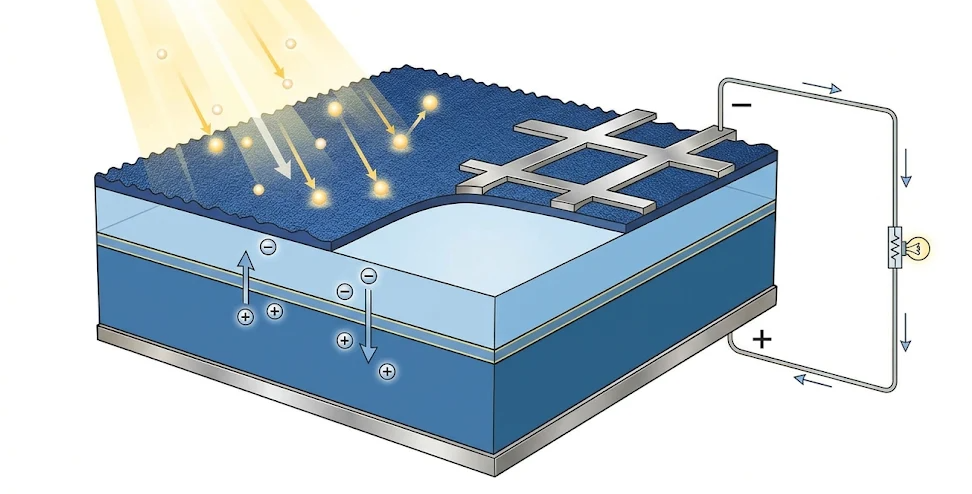
The cell is manufactured with an electric field built into it, and its surface is treated so that freed electrons move toward the front. That movement creates an imbalance of charge between the front and back of the cell, which produces a voltage, much like the terminals of a battery. When the cell is connected to a circuit, electrons flow through it in one direction for as long as light keeps arriving.
Nothing inside the cell reverses that flow. Producing AC requires electronic switching that repeatedly reverses the direction of the current, and a solar cell contains no such mechanism. Think of a pump pushing water around a loop in one direction, compared with a piston forcing water back and forth. A solar cell behaves like the pump.
This matters because it explains why every solar system needs some form of power conversion if it is going to feed household AC circuits or the grid.
What Is the Difference Between AC and DC Electricity?
The core difference is direction. In DC, current flows one way at a steady voltage. In AC, current and voltage reverse direction in a repeating pattern.
What Is Direct Current (DC)?
Direct current keeps a constant voltage and flows in one direction through a circuit. By convention, current is described as flowing from the positive terminal to the negative terminal of the source. Batteries are the most familiar DC source. Each has a positive and a negative terminal, and the current always moves the same way while it discharges.
Common DC sources and uses include PV cells, batteries, electric vehicle battery packs, and the internal circuits of phones and laptops.
What Is Alternating Current (AC)?
Alternating current changes direction periodically, and its voltage swings between positive and negative in a smooth, repeating wave called a sine wave. The number of repeats per second is the frequency. It is 60 hertz (Hz) in the United States and Canada, and 50 Hz in the United Kingdom, Australia and many other regions. Typical household supply is about 120 and 240 volts in North America and about 230 volts in the UK and Australia, though your local utility sets the exact standard.
AC became the standard for power grids for practical reasons. Rotating generators naturally produce AC, and transformers can raise or lower AC voltage easily, which makes high voltage long distance delivery efficient.
That does not make AC better in every situation. Batteries, solar cells, electronics and electric vehicles are DC by nature, and high voltage DC lines are used on some long distance links.
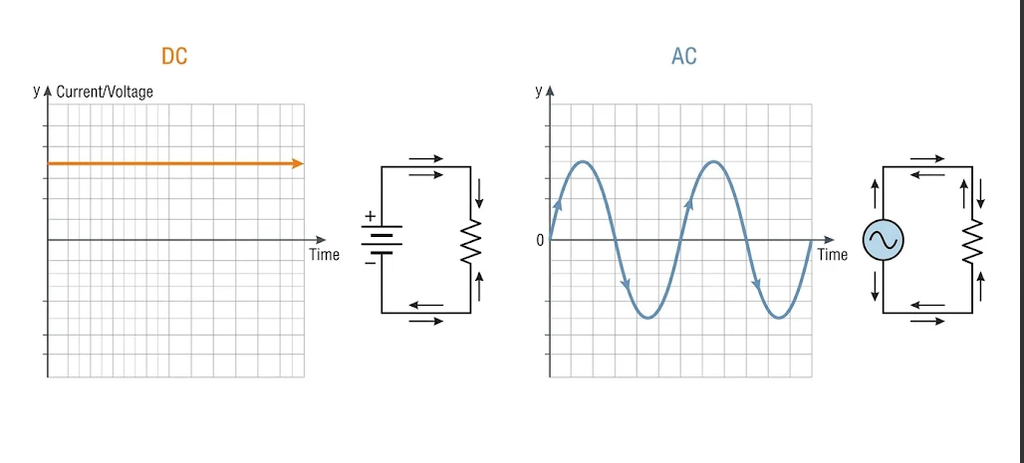
AC vs. DC: Key Differences
| Feature | Direct current (DC) | Alternating current (AC) |
|---|---|---|
| Direction of flow | One direction | Reverses repeatedly |
| Voltage pattern | Steady | Rises and falls in a sine wave |
| Typical sources | Solar cells, batteries | Generators, the utility grid, inverters |
| Typical uses | Electronics, battery storage, EV batteries | Wall sockets, household appliances, power grids |
| Changing voltage | Needs electronic converters | Transformers can step it up or down |
From Cell to Array: How Panels Build Usable DC Power
A single PV cell produces only about 1 or 2 watts, according to the EIA, which is enough for a calculator but not a home. Manufacturers connect many cells inside one weather tight panel, also called a module. Panels are then grouped into an array. The more cells and panels connected, the more electricity the array can produce.
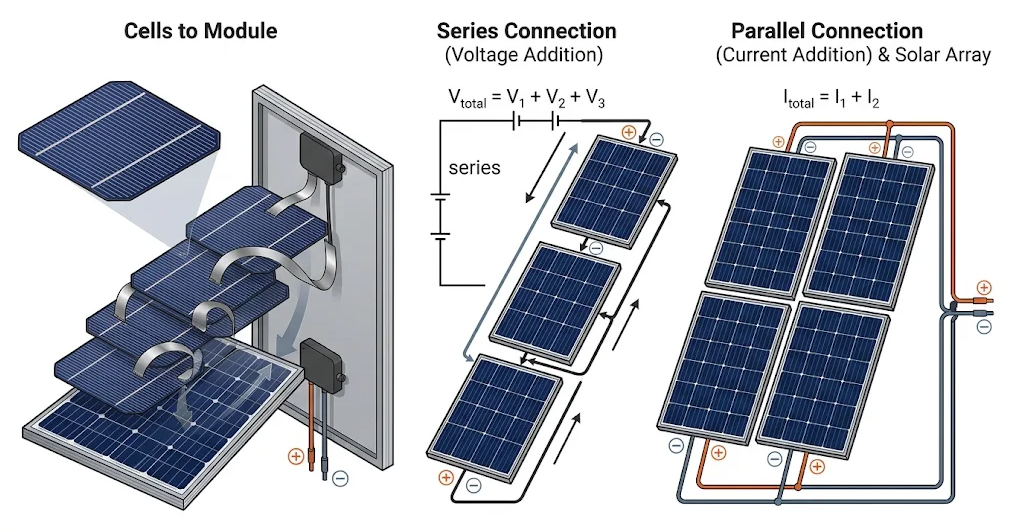
The wiring pattern changes the electrical result. Panels wired in series, one after another, add their voltages and form a string. Panels wired in parallel add their current instead. Installers choose the layout to match the voltage and current limits of the inverter, so the DC that reaches the inverter is shaped by the system design.
The key point for readers is that every stage up to the inverter is DC. Cell, module, string and array all carry direct current.
What Happens Before Solar Power Reaches Your Home?
The usual path is: Sunlight → Solar PV cells → DC electricity → Solar inverter → AC electricity → Electrical panel → Household circuits → Appliances. The table shows what form the electricity takes at each stage. System designs vary, so treat it as the typical grid connected case.
| Stage | Electricity form | Main component | What happens |
|---|---|---|---|
| 1. Sunlight arrives | Light (photons) | Solar panels | Photons reach the PV cells |
| 2. Generation | DC | PV cells and modules | Absorbed photons free electrons and create DC |
| 3. Collection | DC | Wiring, strings, module level electronics | DC travels from the array to the inverter |
| 4. Conversion | DC in, AC out | Inverter | Switching electronics produce AC that matches the grid |
| 5. Distribution | AC | Electrical panel | AC is shared among the home’s circuits |
| 6. Use | AC, often converted to DC inside devices | Appliances and electronics | Loads draw the power they need |
| 7. Surplus | Depends on the design | Battery, meter, grid, controls | Extra power is stored, exported or reduced |

Step 1: Sunlight Reaches the Solar Panels
Sunlight arrives as photons, either directly from the Sun or scattered by the sky and clouds. PV cells respond to light, not to heat, so a bright, cool day can be better for output than a hot one. Output rises and falls with the Sun’s angle, cloud cover and shading, and it drops to zero at night.
Step 2: Solar Panels Generate DC Electricity
Inside each cell, absorbed photons free electrons and the built in field pushes them one way, as described earlier. This is the step that answers whether solar panels produce AC or DC current: it is DC, and it is DC at every point between the cells and the inverter. The size of the output depends on how much light reaches the cells and how many cells are connected.
Step 3: DC Electricity Travels to the Inverter
Special solar cables carry the DC from the array toward the inverter. What happens next depends on the design:
- String inverter: panels are wired into strings, and DC from each string runs to one central inverter, often mounted on a wall near the electrical panel.
- Microinverters: each panel has a small inverter attached, so the DC path is short and AC cable runs from the roof.
- Optimizers with a string inverter: DC power optimizers condition each panel’s DC output, and the DC still runs to a central inverter.
Rooftop DC wiring can carry high voltage. That is one reason installation belongs to qualified professionals, and why many places require features such as disconnects and rapid shutdown. Check the rules that apply where you live.
Step 4: The Inverter Converts DC to AC
The inverter receives the DC and produces AC with the voltage, frequency and wave shape the home and grid expect. It does this by switching the DC back and forth very quickly with transistors, then smoothing the result into a clean sine wave. The next section explains how this works and what else the inverter does.
Step 5: AC Electricity Reaches the Electrical Panel
The inverter’s AC output connects to the home’s main electrical panel, usually through a protective disconnect, either directly or through a dedicated connection point. The panel is called the breaker panel in the United States and Canada, the consumer unit in the UK, and the switchboard in Australia. Local codes and utility rules decide exactly how and where a solar connection is made.
Step 6: Electricity Powers Your Home
From the panel, AC flows through circuits to lights, outlets and appliances. When the system is producing, household loads generally use that solar power first, and the grid fills any shortfall in a grid connected home.
Not every device uses AC internally. A laptop charger or phone adapter converts AC into DC for the battery. So the electricity may be DC at the panel, AC through the house, and DC again inside the device. That extra conversion is a normal feature of how homes are wired today.
Step 7: Excess Solar Electricity Goes to a Battery or the Grid
When the panels produce more than the home uses, three outcomes are possible, depending on the design:
- Charge a battery, if the system includes one.
- Export to the utility grid, if the system is connected and the utility allows it.
- Be reduced or curtailed by the system’s controls, for example when a battery is full and exporting is not allowed or limited.
Not every solar system has a battery, and not every system exports power. How exported electricity is credited, through net metering or other schemes, varies by country, state and utility.
What Does a Solar Inverter Actually Do?
An inverter does more than change the label from DC to AC. It converts power, manages how the system operates, and in a grid connected system it must work in step with the grid.
How DC to AC Conversion Works
According to the U.S. Department of Energy, an inverter makes AC by switching the direction of a DC input back and forth very rapidly. Filters and control electronics then shape the output into a clean, repeating sine wave, which is the pattern grid equipment is built for. Today the switches are transistors made of semiconductors such as silicon, with no moving parts. The first inverters, around a century ago, were mechanical machines that physically reversed connections.
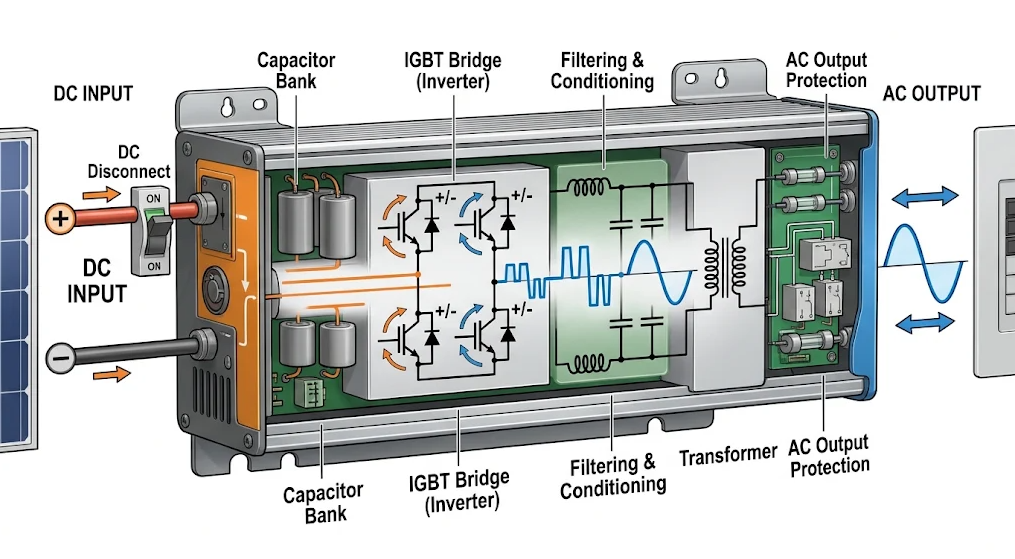
A household inverter typically also monitors the system and communicates with networks. Many also track the point where the array delivers the most power, a function called maximum power point tracking.
Why Inverter Efficiency Matters
No conversion is perfect. Some energy turns into heat inside the inverter. Manufacturers often quote peak efficiencies of about 95 to 98 percent for modern units. As an example, if an array sends 5,000 watts of DC to an inverter running at 97 percent, about 4,850 watts of AC come out and roughly 150 watts become heat. Real world efficiency varies with load and temperature, so look at the weighted efficiency rating on the data sheet.
Every extra conversion adds a small loss, which is why battery coupling choices, covered below, can affect overall efficiency.
Why Grid Tied Inverters Need Grid Synchronization
A standard grid connected inverter is grid following. It reads the voltage, frequency and timing of the grid and matches them, so its AC adds smoothly to the utility’s AC. The Department of Energy notes that these inverters need the grid’s signal to know when to switch.
This has an important safety consequence. Small inverters ride through minor disturbances, but if the grid goes down or the disturbance is large or lasting, they disconnect and shut down. That prevents the system from feeding power into lines that utility crews may be repairing. This is why a typical grid tied solar system does not keep your lights on in an outage. Backup power requires equipment designed for it, such as a battery with an inverter that can operate on its own and a way to isolate the home from the grid. More advanced grid forming inverters can create the reference signal themselves.
Do All Solar Systems Convert DC to AC in the Same Way?
No. The conversion always happens, but where it happens differs. The photovoltaic cells always generate DC. The equipment around them decides where that DC is turned into AC.
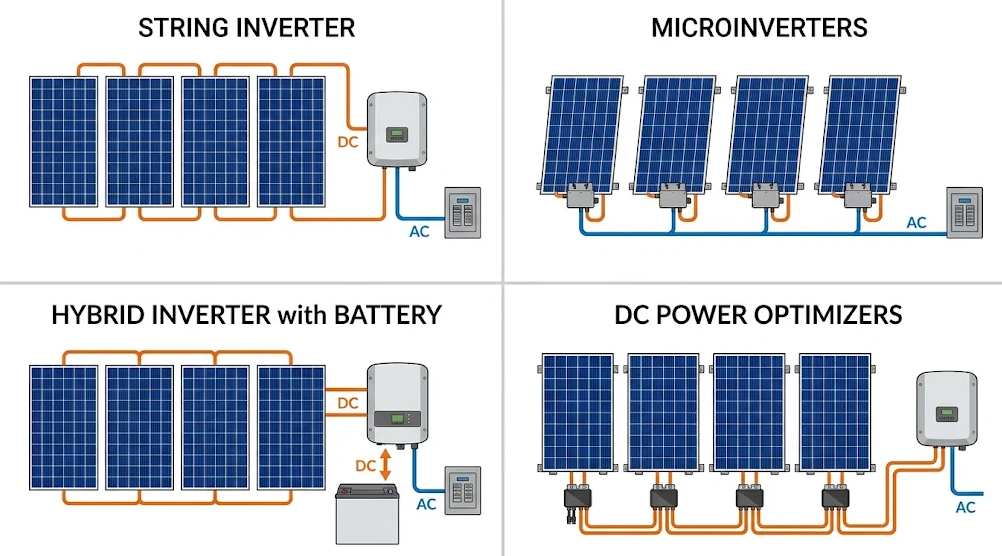
| Equipment | How it works | Where conversion occurs | Key advantages | Important limitations |
|---|---|---|---|---|
| String inverter | Panels are wired in strings that feed one inverter | At a central unit, often near the electrical panel | Cost effective, easy to service in one place | A shaded or weak panel can reduce the output of its string |
| Microinverter | A small inverter sits at each panel | At each module | Panels work independently, panel level monitoring | Higher cost, electronics on the roof |
| Hybrid inverter | Manages solar, a battery and the grid in one unit | At the inverter, with battery connection on the DC side | Handles storage and grid together | Must be compatible with the chosen battery |
| DC power optimizer | Conditions each panel’s DC output, used with a string inverter | Not a converter to AC; the inverter still does that | Reduces shading losses, panel level data | Adds cost and extra devices on the roof |
String Inverters
In a string system, several panels are connected into a string and their combined DC feeds a central inverter. The design is common and cost effective. Its main weakness is shading, because the Department of Energy notes that a problem with one panel, such as shade, reduces the power from the string.
Microinverters and “AC Panels”
A microinverter converts one module’s DC output into AC right at the panel. Shade or damage on one panel does not drag down the others. This is where the question “are solar panels DC or AC” gets confusing. “AC panels” are simply DC panels with a microinverter built in. The photovoltaic cells inside still generate DC. The microinverter converts it into AC at the module level.
Hybrid Inverters
A hybrid inverter can handle solar generation, battery charging and discharging, and grid interaction in one device. How power moves between the battery and the inverter depends on the specific product and system design, so compatibility matters.
DC Power Optimizers
A DC power optimizer is attached to a panel or small group of panels and adjusts its DC output so each panel can operate at its best point. It is a DC to DC device. It does not produce AC. The central string inverter that follows it still performs the conversion to AC.
AC Coupled vs. DC Coupled Solar Battery Systems
Batteries store energy and deliver it as DC. The coupling type describes where the battery connects to the system, and therefore how many conversions the energy goes through.
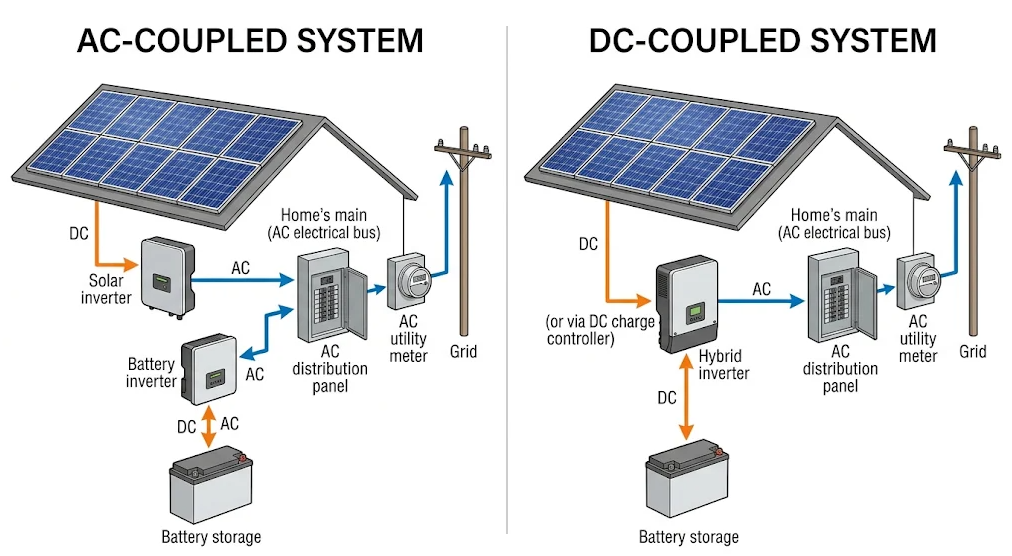
| Feature | DC coupled | AC coupled |
|---|---|---|
| Where the battery connects | On the DC side, before the main inverter | On the AC side, after the solar inverter |
| Solar to battery path | Solar DC charges the battery as DC | Solar DC is converted to AC, then back to DC to charge |
| Discharge path | Battery DC is converted to AC once for the home | Battery DC is converted to AC by a battery inverter |
| Number of conversions | Fewer | More, in some routes up to three |
| Equipment | Hybrid inverter or DC compatible battery system | Battery with its own inverter, or a separate battery inverter |
| Often suited to | New systems | Adding storage to an existing solar system |
| Main trade offs | Needs compatible equipment, can be more complex to install | Extra conversions mean small additional losses |
Neither is better in every case. DC coupling tends to be more efficient because of fewer conversions, while AC coupling is often simpler and cheaper for adding a battery to a system that already has its own inverter. Compatibility, cost, installation conditions and existing equipment should decide.
Is Solar Power AC or DC in Grid Tied, Off Grid and Hybrid Systems?
If you wonder whether solar power is DC or AC in a particular system, the answer is that it starts as DC everywhere and becomes AC wherever an AC load or the grid needs it. The difference is the route.
Grid Tied Solar Systems
A grid tied system connects to the utility, usually without a battery. Panels send DC to an inverter, AC goes to the electrical panel, the home uses it, and any surplus may be exported. At night the home draws from the grid. In an outage the inverter normally shuts down, as explained above.
Off Grid Solar Systems
An off grid system has no utility connection. Panels feed a charge controller, which regulates the DC to charge a battery bank. An inverter then turns battery DC into AC for household appliances, while DC loads such as some lighting or pumps can run straight from the battery side. Because there is no grid to fall back on, the battery and panels must be sized to cover all use, often with a backup generator.
Hybrid Solar Systems
A hybrid system has both a grid connection and a battery, usually managed by a hybrid inverter or an AC coupled battery. It can power the home from solar, the battery or the grid, and can store surplus. Whether it provides backup during an outage depends on the equipment. It needs components designed to isolate the home and supply power on their own.
Frequently Asked Questions About Solar Panels and AC and DC Electricity
Does a solar panel produce AC electricity without an inverter?
No. A standard panel outputs DC. AC panels contain a built in microinverter that does the conversion.
Do solar batteries store AC or DC electricity?
DC. Batteries have positive and negative terminals and deliver current in one direction. Equipment around them converts to AC when the home needs it.
Is electricity in a home AC or DC?
The supply and wiring in a home are AC. Many electronics convert it to DC inside their chargers or power supplies.
Can solar panels power household appliances directly?
Only DC devices, and usually through a regulator or charge controller. Standard AC appliances need an inverter.
Do microinverters produce AC electricity?
Yes. They convert each panel’s DC into AC. The cells still generate DC.
Does a solar system need an inverter?
A system feeding household circuits or the grid does. A small system charging a battery or running DC loads may not.
Can solar panels charge batteries directly?
Yes, because both are DC, but a charge controller or DC coupled equipment should regulate the charging. Connecting them without regulation can damage the battery.
What happens to solar power when the battery is full?
The system sends surplus to the grid if allowed, or reduces panel output so nothing is wasted dangerously. It does not overcharge the battery.
Does solar electricity work during a power outage?
Usually not in a standard grid tied system, because the inverter shuts down for safety. Backup needs a battery and equipment designed to run the home separately.
Do solar panels produce AC or DC current in cloudy weather?
Still DC, only at lower power, since less light reaches the cells.