
Solar energy is the light and heat the Sun radiates into space, and the small part that reaches Earth can be turned into electricity or usable heat. It comes from nuclear fusion in the Sun’s core, where hydrogen nuclei join to form helium and release energy. It counts as renewable because the Sun delivers that energy every day and using it does not use it up.
This guide follows the whole journey: how the energy is made inside the Sun, how sunlight crosses space, why scientists call the Sun the ultimate source of energy, and how solar panels and other technologies capture it. It also explains a point many articles skip. Renewable does not mean unlimited.
What Is Solar Energy?
Solar energy is radiant energy from the Sun, mainly visible light, infrared radiation and a smaller share of ultraviolet radiation. People capture it as electricity with photovoltaic (PV) panels or as heat with solar thermal systems.
Four terms are often mixed up, so it helps to separate them:
| Term | What it means |
|---|---|
| Solar radiation | All the electromagnetic energy the Sun emits |
| Sunlight | The light part of that radiation that we see and feel at the ground |
| Solar heat | Thermal energy produced when a surface absorbs solar radiation |
| Solar electricity | Electrical power made by technology such as PV panels |
Solar energy itself is the natural resource. Panels, collectors and inverters are the technologies people use to capture it.
Where Does Solar Energy Come From?
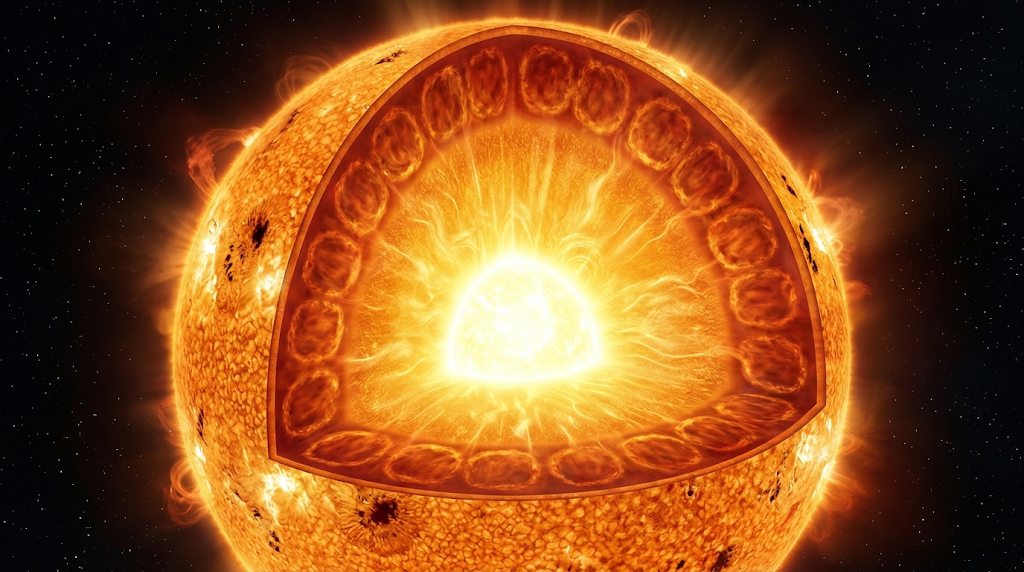
Solar energy comes from nuclear fusion in the core of the Sun. The Sun is about three quarters hydrogen and one quarter helium. In its core, hydrogen nuclei, which are single protons, are squeezed together so hard that they fuse into helium, and each fusion releases energy.
So when people ask where solar power comes from, the honest answer is that a panel does not create energy from nothing. It captures a small share of what the Sun has already released.
Why fusion happens. Hydrogen nuclei carry a positive charge and normally repel each other. In the core, the temperature is about 15 million °C and the pressure is hundreds of billions of times the air pressure at Earth’s surface. Under those conditions, nuclei collide hard enough to overcome the repulsion and fuse.
Where the energy comes from. Four hydrogen nuclei end up as one helium nucleus, and that helium nucleus has slightly less mass than the four nuclei combined. The missing mass becomes energy, as described by Einstein’s equation E = mc². Because c² is an enormous number, even a tiny loss of mass releases a great deal of energy. This is why the Sun can shine for billions of years.
The Sun does not burn like a fire. There is no oxygen and no combustion. It shines because of fusion.
How Is Solar Energy Formed Inside the Sun?
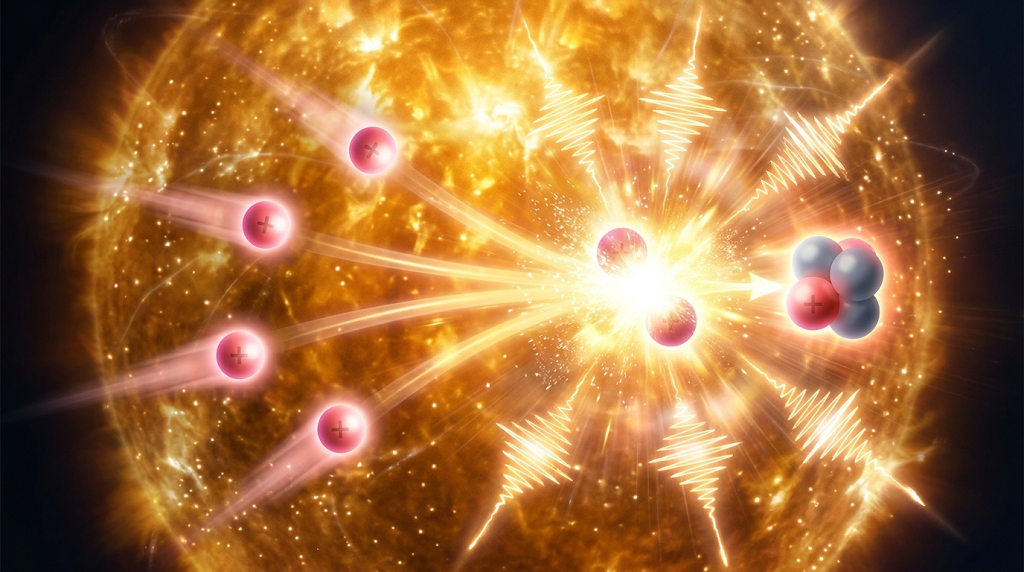
Solar energy is formed through a chain of events that begins in the core and ends with sunlight leaving the Sun:
- Hydrogen fills the core. The Sun’s core is rich in hydrogen, the fuel for fusion.
- Extreme heat and pressure build up. Gravity compresses the core, raising its temperature to about 15 million °C.
- Fusion reactions occur. Through a series of steps called the proton proton chain, four hydrogen nuclei become one helium nucleus.
- Energy is released. The lost mass appears as energy, mostly as very energetic photons, along with particles called neutrinos.
- Energy crosses the radiative zone. Photons are absorbed and emitted again countless times as they work outward. Estimates for the trip range from about 100,000 to 1 million years.
- Energy rises through the convective zone. In the outer layers, hot plasma rises, cools and sinks, carrying energy to the surface much faster.
- The surface emits radiation. The visible surface, the photosphere, releases mostly visible and infrared light into space.
- Sunlight travels to Earth. It crosses about 150 million km in a little over 8 minutes and meets Earth’s atmosphere.
One detail is worth remembering. The energy in sunlight today was made in the core long ago, while the light itself took only minutes to cross space.
Nuclear Fusion vs. Nuclear Fission
Fusion joins light nuclei such as hydrogen into heavier ones such as helium. Fission splits heavy nuclei such as uranium into smaller pieces. Today’s nuclear power plants use fission. The Sun uses fusion. Confusing the two is a common mistake, so it is worth keeping them apart.
How Does Sunlight Travel From the Sun to Earth?
Sunlight travels as electromagnetic radiation, which can move through empty space because it needs no air or other material to carry it. It arrives in packets of energy called photons.
At the top of Earth’s atmosphere, sunlight delivers about 1,361 watts per square meter, a value known as the solar constant. Not all of it reaches the ground. Gases, dust, water vapor and clouds absorb, scatter or reflect part of it.
The light that does arrive comes in two forms. Direct sunlight travels in a straight line from the Sun. Diffuse sunlight has been scattered by the atmosphere and clouds. This matters later, because PV panels can use both, while concentrating solar power plants rely on direct sunlight.
What Form of Energy Is Sunlight?
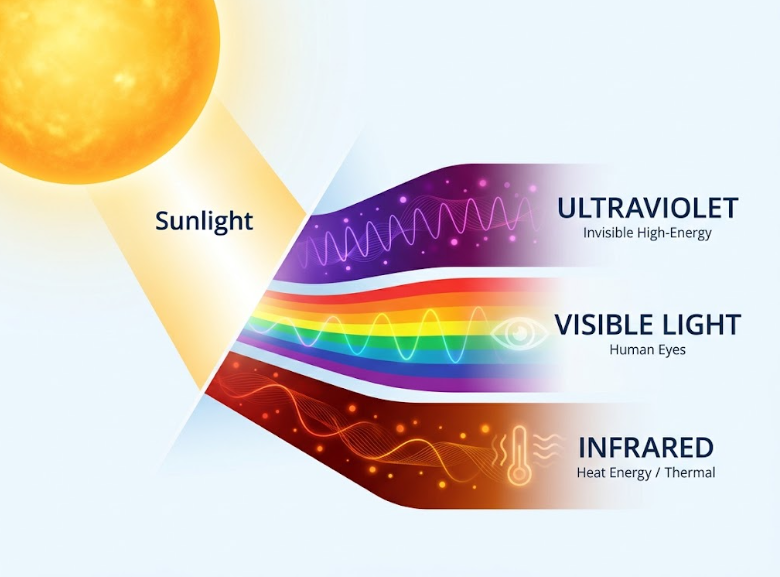
Sunlight is electromagnetic radiation, also called radiant energy. It is made of photons and spans several parts of the spectrum:
- Visible light: the part our eyes detect.
- Infrared radiation: the part we feel as warmth.
- Ultraviolet radiation: a smaller share, much of which is absorbed by the atmosphere.
Light energy and thermal energy are related but different. Light is radiant energy in transit. When a surface absorbs it, the energy can become thermal energy, which is why a dark car seat heats up in the sun.
Radiant energy can be converted into other forms. PV cells turn it into electrical energy. Solar collectors turn it into heat. Plants turn it into chemical energy through photosynthesis. Choosing the right technology depends on which form you need.
Is the Sun a Natural Resource?
Yes. A natural resource is something found in nature that people can use, and the Sun supplies light and heat that humans use for electricity, warmth, drying, farming and more. Sunlight is therefore a natural resource, and a renewable one.
Natural resources fall into two broad groups:
- Nonrenewable resources, such as coal, oil, natural gas and uranium ore, formed over geological time and are used faster than they can be replaced.
- Renewable resources, such as sunlight, wind and flowing water, are replenished on a human timescale.
There is also a useful difference in how they behave. Coal is a stock: once it is burned, it is gone. Sunlight is a flow: it keeps arriving, and using it today does not reduce tomorrow’s supply.
Why Is the Sun Called the Ultimate Source of Energy?
The Sun is called the ultimate source of energy because it powers Earth’s climate, its living systems and most of the energy people use. The EIA describes it as the original source of nearly all the energy we use, and the word “nearly” matters. So what is the main source of energy for Earth? For the surface, the climate and life, it is the Sun.

Here is how sunlight connects to other energy systems:
| Energy system | Link to the Sun |
|---|---|
| Food and biomass | Plants use sunlight in photosynthesis, and food chains and wood or crop fuels depend on it |
| Fossil fuels | Formed from ancient plants and plankton that once captured sunlight |
| Wind | Uneven solar heating of Earth’s surface and atmosphere creates pressure differences and wind |
| Water cycle and hydropower | Solar heat evaporates water, which falls as rain and fills rivers and reservoirs |
| Ocean and atmospheric processes | Solar heating drives currents, weather patterns and waves |
Not every energy source traces back to sunlight:
- Geothermal energy comes from heat inside Earth, left over from the planet’s formation and produced by radioactive decay.
- Nuclear fission power uses uranium, which was formed in stars long before the Sun existed.
- Tidal energy comes mainly from the gravity of the Moon and Sun and from Earth’s rotation.
So “ultimate source” is correct for most of the energy we use, but not for all of it.
Why Is Solar Energy Renewable?
Solar energy is renewable because sunlight is replenished continuously and using it does not deplete the supply. Energy agencies describe renewable energy as coming from natural sources that replenish faster than we consume them. Each day brings new sunlight, and no amount of panels on Earth changes how much the Sun emits.
The scale is large. Estimates generally say that between one and two hours of sunlight reaching Earth carries about as much energy as humanity uses in a year.
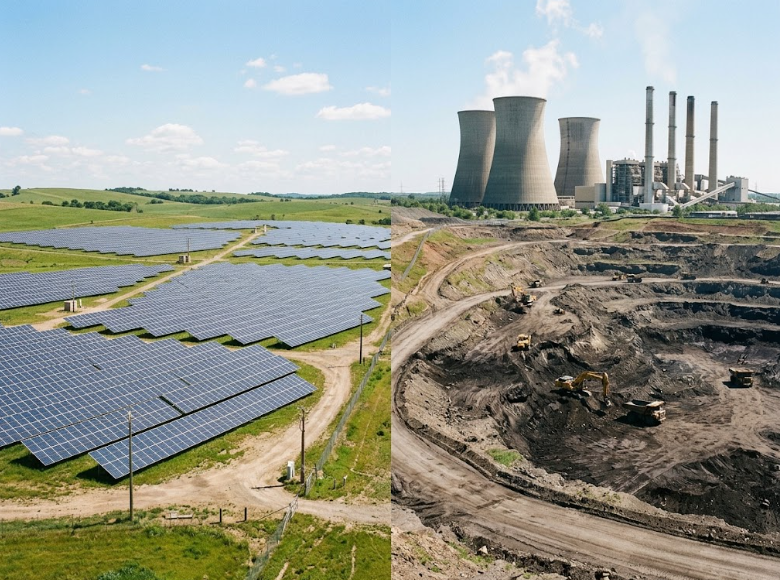
| Feature | Solar (renewable) | Coal, oil and gas (nonrenewable) |
|---|---|---|
| Supply | Replenished continuously by the Sun | Formed over millions of years |
| Effect of use | Does not reduce the sunlight available | Reserves shrink as they are burned |
| Type of resource | Flow | Stock |
| Emissions during operation | No air pollutants or carbon dioxide from operating solar systems, according to the EIA | Burning releases carbon dioxide and other pollutants |
Is the Sun a renewable resource? In a strict sense, the Sun’s hydrogen is finite and is not replaced. The Sun has about 5 billion years of core hydrogen fusion left. Solar energy counts as renewable because that is far beyond any human timescale, and because each day’s sunlight arrives afresh. That is also why sunlight is considered a renewable resource: our use takes nothing away from future supply.
Is Solar Energy Completely Unlimited?
No. Renewable and unlimited are different ideas, and treating them as the same is a common error. There are four limits to keep in mind:
- The Sun is finite. It will not shine forever, though the timescale is billions of years.
- Sunlight is flow limited. The power reaching any square meter is limited, and it changes with time of day, season, latitude and weather. That is why solar needs large collection areas and, often, storage.
- Equipment wears out. PV modules commonly last 20 to 30 years. The energy source is renewable, but the hardware is not.
- Equipment has environmental costs. Mining materials, manufacturing, shipping, installation, land use and disposal all have impacts. Statkraft notes that about 80 to 90 percent of a panel is glass and aluminum, which are recyclable, though recycling at scale is still developing. Studies generally find panels produce more energy over their lifetime than is used to make them, so check current figures from NREL for exact payback times.
Being honest about these limits does not weaken the case for solar. It simply keeps the claim accurate.
How Can We Get Energy From the Sun?
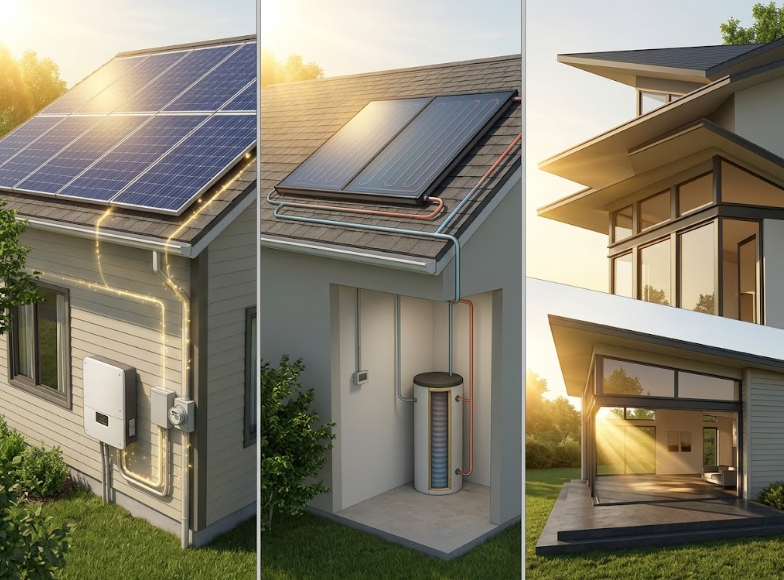
There are three main ways to use solar energy. Each captures a different form of it.
| Technology | What it captures | What it produces | Everyday example |
|---|---|---|---|
| Solar photovoltaic (PV) | Photons of light | Electricity | Rooftop panels, calculators |
| Solar thermal collectors | Heat from sunlight | Hot water or warm air | Solar water heaters |
| Concentrating solar power | Concentrated direct sunlight | Steam, then electricity | Large power plants in sunny regions |
| Passive solar design | Sunlight and heat through building design | Warmth and daylight without machines | Well placed windows and thermal mass |
Solar energy is the resource. PV, collectors and passive design are the technologies that capture it.
Solar Photovoltaic Technology
A solar cell is a thin slice of semiconductor material, most often silicon. This is how it turns light into electricity:
- Photons strike the cell. Some are reflected, some pass through and some are absorbed. Only absorbed photons provide energy.
- Electrons are freed. An absorbed photon gives its energy to an electron in the semiconductor, which breaks free. This is the photovoltaic effect.
- An electric field pushes the electrons one way. The cell is built with a field inside it, so freed electrons flow in one direction and form a current.
- Metal contacts collect the current. The output is direct current (DC).
- An inverter converts DC to AC. Household appliances and the grid use alternating current (AC).
- The electricity is used, stored or exported. A home uses what it needs, and the surplus can charge a battery or flow to the grid.
A note on terms: some pages call this the photoelectric effect. The two effects are related, but the photoelectric effect ejects electrons from a surface, while the photovoltaic effect creates a voltage inside the material. For solar cells, photovoltaic effect is the precise term.
Panels still work on cloudy days, because they can use diffuse light, though output is lower.
Solar Thermal Technology
Solar thermal systems capture heat rather than making electricity directly. Collectors absorb sunlight and warm water or air, which is how solar water heaters supply homes, buildings and pools. Concentrating solar power uses mirrors to focus sunlight, heat a fluid, make steam and drive a turbine. These plants depend on direct sunlight.
Passive Solar Design
Passive solar design uses a building’s orientation, windows, insulation and materials to collect, store and spread the Sun’s warmth and light with no mechanical equipment. Overhangs and shades block high summer sun to keep a building cool, while well placed windows let in lower winter sun. It reduces the energy a building needs in the first place.
How Is Solar Energy Extracted?
Solar energy is not extracted like coal, oil or gas. Nothing is dug up or drilled. It is captured and converted while sunlight arrives, and the resource stays available afterward.
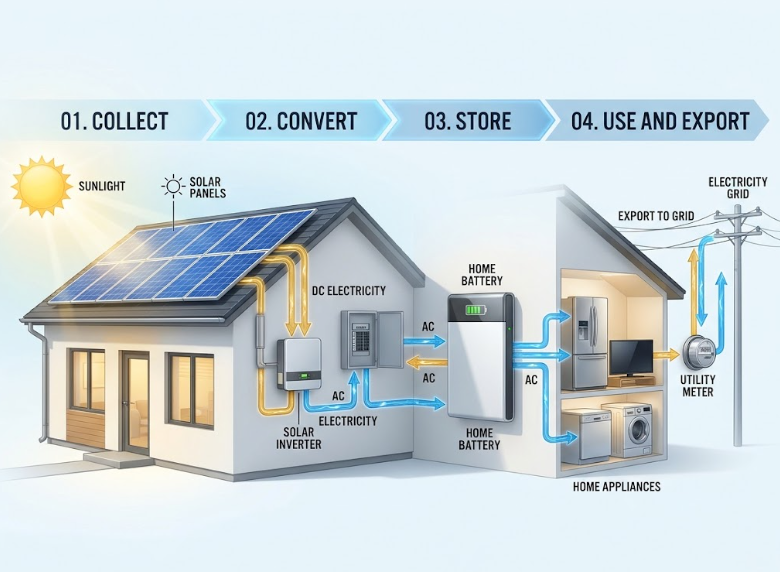
The process has four distinct stages:
- Collect. A panel or collector absorbs incoming sunlight.
- Convert. PV cells turn light into DC electricity, or collectors turn light into heat.
- Store. Electricity can be held in batteries, and heat can be held in insulated tanks or other thermal storage.
- Export. Surplus electricity can flow to the grid. Whether and how a household is credited depends on local rules, such as net metering policies.
This also shows the difference between formation and capture. Inside the Sun, energy is formed by fusion. On Earth, people do not make solar energy. They capture and convert what the Sun has already sent.