
Welcome to AGHow, where we explain solar energy, solar panels, batteries, costs, and other clean-energy topics in simple, practical terms.
A solar panel turns sunlight into electricity through the photovoltaic effect. Each panel is built from solar cells, thin slices of a semiconductor (usually silicon) that release electric charges when light hits them. A built in electric field inside each cell pushes those charges in one direction, so they flow out through metal contacts as direct current (DC). That is how solar cells create electricity: light supplies the energy, and the cell’s structure supplies the direction.
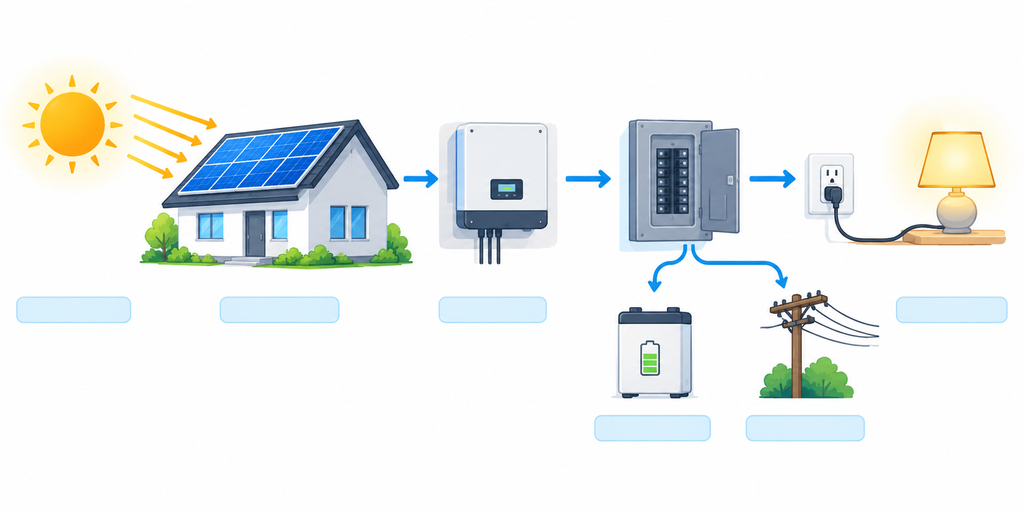
Your home does not run on DC, though. An inverter converts the panel’s DC into alternating current (AC), the kind your outlets and appliances expect. From the inverter the power goes to your home’s electrical panel, then out to your circuits, with any surplus going to a battery or the grid depending on how the system is built.
The rest of this page follows that trip one step at a time, with one question in mind: what actually happens between sunlight hitting the roof and power coming out of the wall?
How Solar Panels Work in One Simple Explanation
- Sunlight reaches the cells. Light arrives as photons, tiny packets of energy.
- Photons give energy to electrons. In the silicon, some electrons absorb enough energy to break free.
- The cell separates the charges. A built in electric field pulls free electrons one way and the gaps they leave behind the other way.
- Current flows. Metal contacts collect the charges, and when a circuit is connected, they flow as DC electricity.
- Cells combine into a panel. Dozens of cells wired together produce a useful voltage and current.
- An inverter converts DC to AC. The result can power your home, charge a battery, or flow to the grid.
The short version: sunlight → photovoltaic cells → DC electricity → inverter → AC electricity → home → battery or grid.
What Happens Inside a Solar Cell?
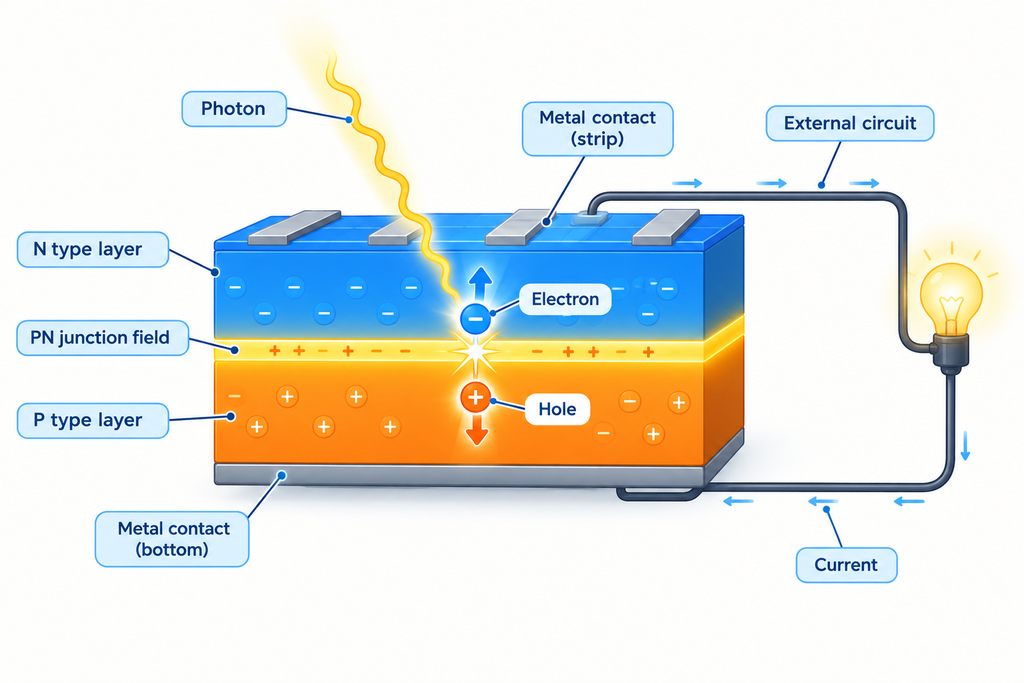
A solar cell is a semiconductor device that converts light into electricity. To see how, start with silicon.
In a silicon crystal, each atom shares electrons with its neighbors, and those electrons are normally locked in place. A semiconductor is a material where a modest amount of energy can free them. For silicon that threshold is about 1.1 electron volts, and photons in sunlight carry roughly that much energy or more.
When a photon with enough energy is absorbed, it frees an electron. The electron leaves behind a vacancy called a hole, which behaves like a positive charge that can move through the crystal. This freed electron and its hole are called an electron hole pair.
Freed electrons alone do not make a useful current. They wander randomly and soon fall back into holes, releasing their energy as heat. The cell needs a way to separate them. That is the job of the PN junction.
Doping and the junction. Manufacturers add tiny amounts of other elements to the silicon on purpose:
- N type silicon is doped (commonly with phosphorus) so it has extra free electrons.
- P type silicon is doped (commonly with boron) so it has a shortage of electrons, meaning extra holes.
Where the two layers meet, electrons from the n side drift across into the p side, and holes drift the other way. That leaves the n side slightly positive and the p side slightly negative near the boundary, which sets up a permanent built in electric field across the junction.
You can picture that field as a one way slope. Charge carriers created near the junction get sorted by it: electrons are pushed toward the n side, and holes toward the p side. The analogy is only a picture; the real mechanism is the electric field acting on charged particles.
With electrons collecting on one side and holes on the other, there is a voltage between the two sides of the cell. Attach metal contacts to the top and back, connect a load such as a light or an inverter, and the electrons travel through that external circuit to reach the holes on the other side. That flow is the electric current.
Not every photon is useful. Photons with too little energy pass through or turn into heat. Photons with more energy than needed waste the excess as heat. This is one reason a cell can convert only part of the sunlight that reaches it.
How the Photovoltaic Effect Creates Electricity
The photovoltaic effect is the production of a voltage and electric current in a material when light is absorbed. In a solar cell, absorbed photons create electron hole pairs, the junction’s electric field separates them, and an external circuit lets them flow as current.
Four terms are often mixed up in solar writing, so here they are kept apart:
- Energy is the capacity to do work, measured in watt hours or kilowatt hours (kWh). Your electricity bill is mostly about energy.
- Voltage is the electrical push, like pressure in a pipe, measured in volts.
- Current is the amount of charge flowing, like the flow rate in a pipe, measured in amperes (amps).
- Power is the rate at which energy is delivered or used, measured in watts.
They connect through two simple relationships.
P = V × I. Power equals voltage times current. A panel operating at 30 volts and 10 amps is delivering 300 watts. (Illustrative numbers, not a specific product.)
Energy = power × time. If that panel delivered a steady 300 watts for 2 hours, it would produce 0.6 kWh. A panel’s watt rating tells you its power under standard test conditions. It does not tell you how much energy it makes in a day, which depends on how much sun it actually gets.
One useful detail: in a single silicon cell, voltage stays roughly half a volt across a wide range of light levels, while current rises nearly in proportion to the light and the cell’s area. That is why a cell on a cloudy day produces less power mainly because of lower current, not much lower voltage.
How Solar Cells Become a Solar Panel
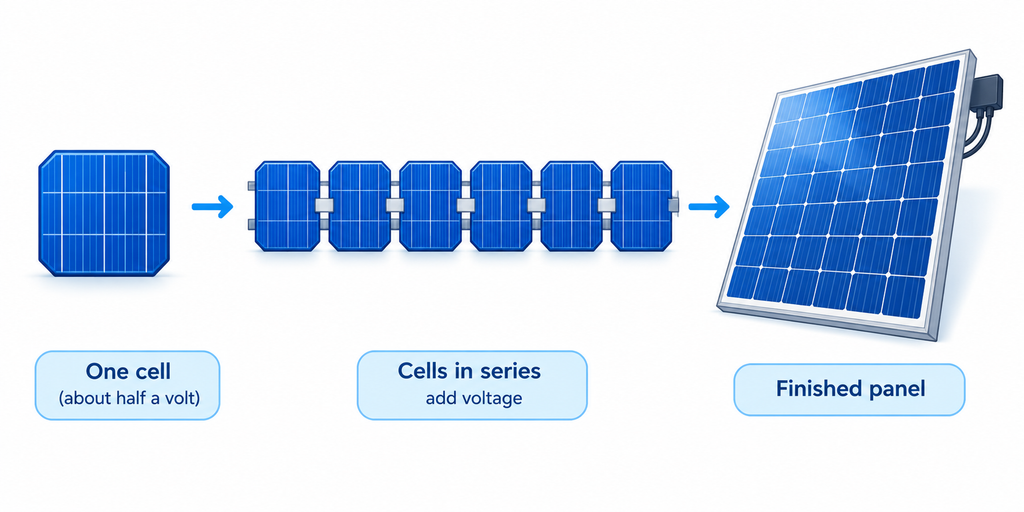
A single silicon solar cell produces only about half a volt. That cannot run a house, so cells are wired together.
- Series connection links cells end to end. Voltages add, while the current stays about the same as one cell’s. Wiring many cells in series raises the panel’s voltage to a practical level.
- Parallel connection links cells side by side. Currents add, while voltage stays the same. It is used in some module layouts and when wiring multiple strings together.
Most residential panels have traditionally used 60 or 72 cells, though newer designs use half cut or other cell formats. The cells are soldered together, sealed between glass and a protective backsheet, and surrounded by a frame with a junction box on the back. Bypass diodes inside the panel let current route around a shaded section instead of choking the whole panel.
Why not one giant cell? Making a cell bigger raises its current, not its voltage. Very high currents need thick conductors and waste more energy as heat in the wiring. Large silicon wafers are also fragile and hard to make. Many small cells in series give a higher voltage and a manageable current, which is the combination that moves power efficiently.
For the exact meaning of cell, module, array and system, see the terminology table further down.
How Solar Panels Work Step by Step
- Sunlight reaches the panel. Glass and an anti reflective coating let most of the light through to the cells.
- Photons enter the semiconductor. Light is absorbed in the silicon layers.
- Electrons gain energy. Photons with enough energy lift electrons out of their bonds.
- Electron hole pairs form. Each freed electron leaves a hole behind.
- The PN junction separates the charges. Electrons head toward the n side, holes toward the p side.
- The electric field drives the movement. The built in field keeps the carriers from simply recombining.
- An external circuit lets current flow. Metal contacts and wiring give the electrons a path.
- The panel produces DC electricity. The current always flows in one direction.
- The inverter converts DC to AC. It also matches the grid’s frequency and handles safety and control.
- The power goes where the system sends it. It can run appliances, charge a battery, or flow to or from the grid, depending on system design.
How Solar Electricity Gets From the Roof to Your Outlet
Here is the question that trips most people up. If the panels make electricity on the roof, why can’t it simply run straight into a wall outlet?
Because the two sides speak different electrical languages. Panels produce DC at a voltage that rises and falls with sunlight and temperature. Outlets deliver AC at a fixed voltage and frequency set by the local grid, and appliances are built for that. Something has to translate, and that something is the inverter.
The path in a typical home system looks like this:
Sun → panels → DC electricity → inverter → AC electricity → electrical panel → household circuits → outlet → appliance
What the inverter actually does. Its headline job is converting DC to AC. In most modern systems it does more. It adjusts the electrical operating point of the panels to pull out as much power as the sunlight allows (called maximum power point tracking). In a grid connected system it also matches the grid’s voltage and frequency before sending power out. It monitors the system and includes protection functions such as ground fault detection. Systems differ here: a single string inverter handles a whole group of panels, while microinverters sit behind individual panels, and designs with power optimizers split the work between the roof and a central unit. The U.S. Department of Energy describes inverters as one of the most important pieces of equipment in a solar energy system.
What the electrical panel does. The electrical panel (also called the breaker box or service panel) is the distribution point for your home’s AC. The inverter feeds into it through a breaker, the utility connection feeds into it too, and from there breakers send power out to your circuits. It is also where the protective devices live.
One more clarification. Solar power does not take a private route from a particular panel to a particular outlet. Inside the house, the roof system and the grid feed the same electrical system, and every appliance draws what it needs from it. Your toaster cannot tell where its power originated. In AC wiring the charges mostly shuffle back and forth rather than travel from the roof to the plug; what moves through the circuit is energy. In practical terms, when the panels produce enough, they cover the house’s demand first, and the grid or a battery fills any gap.
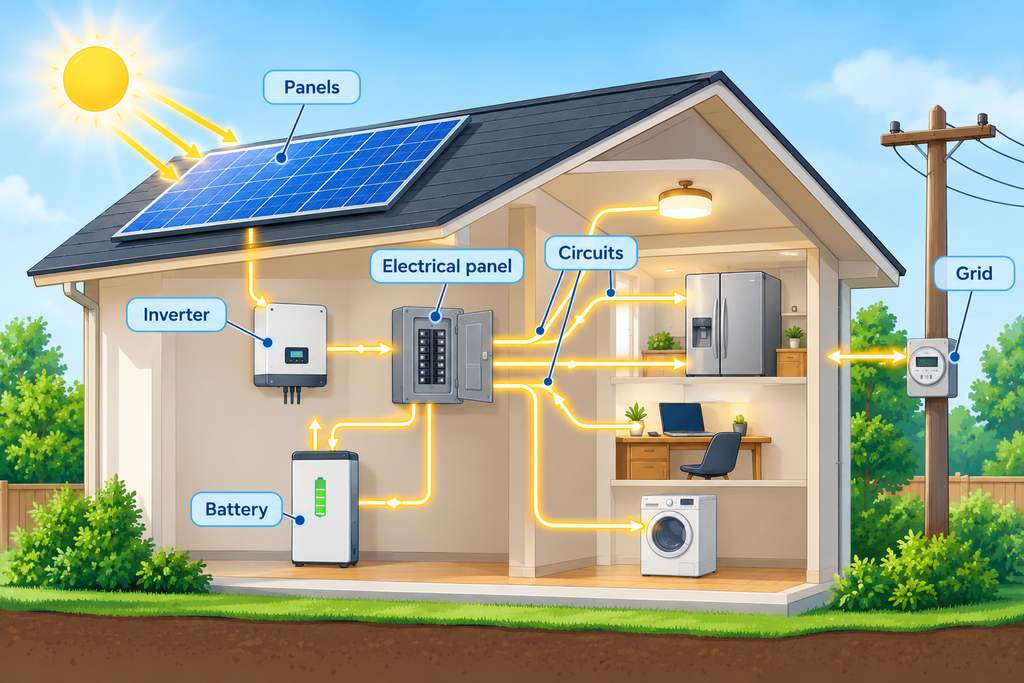
A sunny afternoon, start to finish. Imagine the panels are producing steadily in bright sun. Photons strike the cells, charges separate at the junctions, and DC flows to the inverter. The inverter turns it into AC and sends it to the electrical panel. The refrigerator, a laptop charger and the dishwasher draw what they need through their circuits. If the panels produce more than the house uses at that moment, the surplus goes to a battery if there is one, or out to the grid if the system and local rules allow it. No numbers are needed to follow this; the point is that the roof, the inverter and the house act as one electrical system.
What Happens to Extra Solar Electricity?
When solar production exceeds what the home is using, the extra can go several places, depending on how the system is built:
- Household use first. Running appliances absorb production directly, which is usually the most efficient use.
- Battery storage. A battery stores electrical energy in chemical form for later, such as the evening. Our guide to how to store solar energy covers how this works in more detail.
- Export to the grid. In a grid connected system, surplus power can flow out to the utility network where the system and the local rules permit it.
- Curtailment or system control. Some systems are limited or throttled by the inverter, for example when export is capped or the battery is full, so the panels deliberately produce less than they could.
What you are paid, credited or allowed to export is not universal. It depends on the utility, the tariff, the location and the system configuration, and these rules change. Check your own utility’s current policy rather than relying on a general statement.
What Happens When the Sun Isn’t Shining?
Panels make electricity only while light reaches the cells. They do not store sunlight. Without light, the photovoltaic effect stops.
- Night: panels produce nothing useful. A grid connected home draws from the grid. A home with a battery can draw on stored energy. An off grid home relies on its battery or another source such as a generator.
- Clouds and haze: light is reduced and scattered, so output falls, but it does not necessarily drop to zero.
- Outages: depends on the system type, covered below.
What Affects How Much Electricity Solar Panels Produce?
A panel’s label gives a rated power in watts, measured under standard laboratory test conditions. Real production, measured in energy over time, depends on conditions that rarely match the lab:
- Sunlight (irradiance): stronger light means more current. This varies by time of day, season, weather and location.
- Orientation and tilt: how directly the panels face the sun across the day and year.
- Shading: even partial shade can disproportionately cut output from a string of panels, depending on the wiring and inverter design.
- Temperature: hotter cells make a lower voltage, so power drops somewhat on hot days even in strong sun.
- Panel efficiency and wattage: efficiency affects how much power a given area makes; wattage is the panel’s rating.
- System losses: wiring resistance, inverter conversion losses, dust and dirt on the glass (soiling), snow, and mismatch between panels.
That is why a higher wattage panel does not always produce more energy in every situation, and why no panel always produces its rated wattage. The question of how much a given panel or system actually produces has its own page: see how much electricity a solar panel produces, and the solar panel calculator if you want to estimate it for your home.
Why Solar Panels Produce DC Electricity
The cell’s built in electric field pushes charge carriers in one direction only. Electrons are swept to the n side, travel through the external circuit, and return to the p side. There is no part of that process that reverses the direction, so the output is direct current, flowing one way.
Generators in power plants behave differently. They spin a coil near a magnet, which naturally produces a current that reverses direction each rotation. A solar cell has no moving parts and no rotation, so it makes DC.
Why Solar Systems Need an Inverter
Homes and the grid use AC largely because AC is easy to step up and down in voltage with transformers, which makes long distance transmission efficient. Appliances and outlets were built around that standard.
| DC | AC | |
|---|---|---|
| Direction of current | One direction | Reverses many times per second |
| Typical sources | Solar cells, batteries | Power plant generators, inverters |
| Where you find it | Panel output, battery storage, electronics internals | Wall outlets, grid transmission |
| Role in solar | What panels produce | What your home and the grid use |
The inverter bridges the gap: conversion, synchronization with the grid in grid connected systems, and safety and control functions. Not all inverters behave the same. Some can only work alongside the grid, while others (typically paired with batteries) can power a home independently when designed to.
Grid Connected, Off Grid and Hybrid Solar Systems
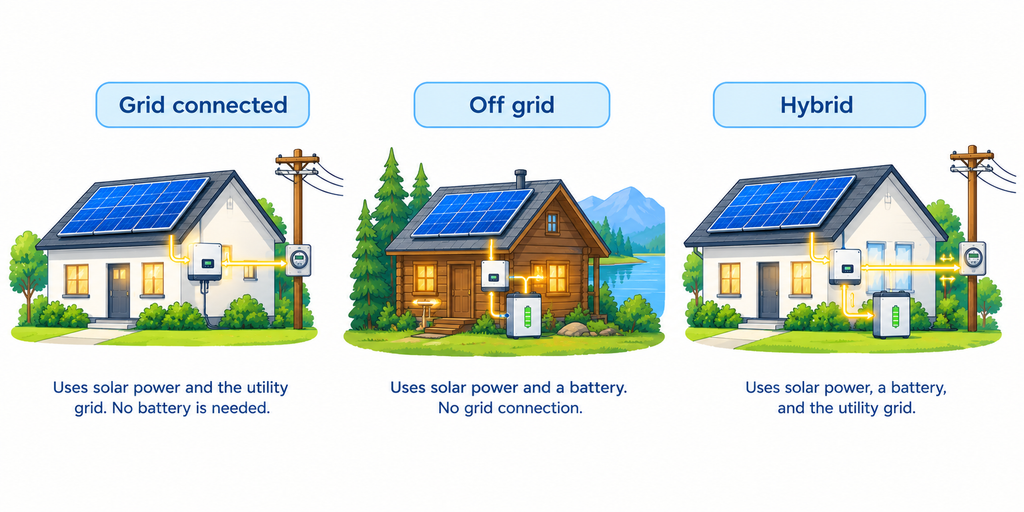
| System | Grid connection | Battery | Main use case | If the grid fails |
|---|---|---|---|---|
| Grid connected | Yes | Usually no | Reduce electricity bought from the utility | Typically shuts down for safety, so no power from the panels unless designed with backup equipment |
| Off grid | No | Yes, essential | Remote homes and sites | Not applicable; it runs independently, limited by sun, battery size and any generator |
| Hybrid | Yes | Yes | Self use plus backup | Can power selected circuits if installed with backup capable equipment; not every hybrid system is set up that way |
The common surprise is the first row. Many people assume panels keep the lights on during a blackout. An ordinary grid connected system normally disconnects when the grid goes down, to protect utility workers repairing lines. Backup power requires equipment and wiring designed for it. The DOE notes that solar plus storage systems can operate without the grid in an outage if they are designed to.
Solar Panels vs Solar Cells vs Solar Arrays
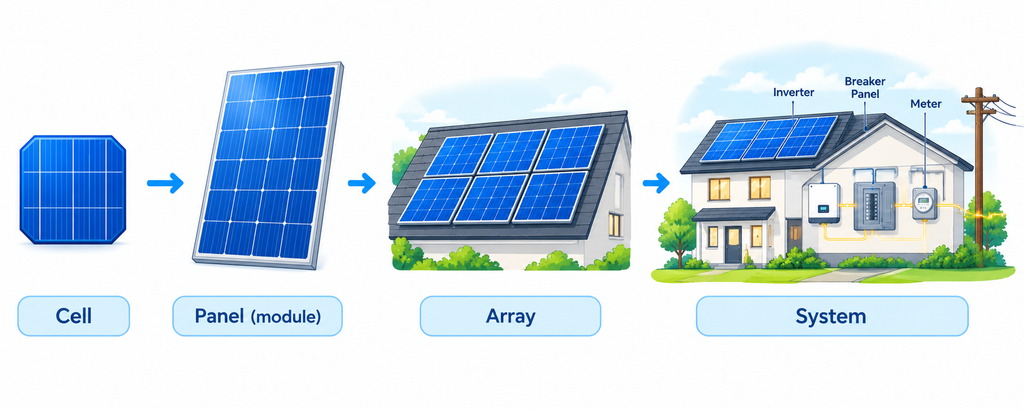
| Term | What it is |
|---|---|
| Solar cell | The basic semiconductor device that converts light to electricity. Produces about half a volt in silicon. |
| Solar panel (module) | Many cells wired together, sealed in glass and a frame. This is the unit you buy and mount. |
| Solar array | Several panels wired together as a group. |
| Solar system | The array plus inverter, wiring, mounting, electrical panel connection, and any battery or monitoring. |
A cell is not a panel, and a panel is not a system. When someone quotes a system, they mean everything in the last row.
Do Solar Panels Work on Cloudy Days?
Yes, but they produce less. Clouds scatter and block sunlight, yet panels still respond to diffuse light, so they keep generating at reduced output. How much less depends on cloud thickness, season and location, so no single percentage applies everywhere.
Do Solar Panels Work at Night?
No. Photovoltaic cells need light, so panels do not generate usable electricity at night. Homes then use the grid, a battery, or another source, depending on the system.
How Efficiently Do Solar Panels Convert Sunlight Into Electricity?
Efficiency is the share of the sunlight striking a panel that comes out as electricity. Many current residential panels are commonly quoted at around one fifth, though the figure varies by model and technology. Check the panel’s datasheet and a current authoritative source such as the national labs or the U.S. Department of Energy rather than treating any one number as universal.
Where does the rest go?
- Photons that can’t be used. Light below the cell’s energy threshold passes through, and light above it wastes the extra energy as heat.
- Reflection. Glass and cell surfaces reflect a small part of the light, which anti reflective coatings reduce.
- Recombination. Some freed electrons fall back into holes before they can be collected.
- Heat. Hot cells make less voltage.
- Electrical losses. Resistance in cells, wiring and the inverter.
- Real conditions. Shade, dirt, mismatch and weather.
The physics of a single junction silicon cell sets a theoretical ceiling in the low 30 percent range, and research designs that stack multiple materials aim to go beyond it. Panels you can buy sit well below laboratory records.
Common Misconceptions About How Solar Panels Work
- Solar panels store electricity. No. Panels generate it while light is present. Storage needs a battery.
- Solar panels only work in hot weather. They need light, not heat. Excess heat actually lowers a panel’s output.
- Solar panels don’t work when it’s cloudy. They work at reduced output.
- Every panel sends electricity directly to one outlet. Power is shared across the home’s electrical system.
- The inverter stores the electricity. No. It converts it. A battery stores it.
- A higher wattage panel always makes more energy. Not in every situation. Shading, heat, orientation and system design matter, and rated power is not daily energy.
- Solar panels generate AC electricity. They generate DC. The inverter makes AC.
- A grid connected system automatically powers the house during an outage. Typically it shuts down unless it has backup capable equipment.
Frequently Asked Questions About How Solar Panels Work
How do solar cells create electricity? Light frees electrons in a semiconductor, and the cell’s PN junction separates the charges so they flow through an external circuit as DC current.
How does a photovoltaic cell work? It absorbs photons, creates electron hole pairs, and uses a built in electric field to push the carriers toward opposite contacts, producing voltage and current.
How do solar panels generate electricity? Many cells wired together each produce a small voltage; combined, they give a panel a practical voltage and current.
Do solar panels produce AC or DC? DC. An inverter converts it to AC for homes and the grid.
What does an inverter do in a solar system? It converts DC to AC, and in many systems also optimizes the panels’ operating point, syncs with the grid and provides safety functions.
What happens to unused solar electricity? It can charge a battery, flow to the grid where permitted, or be limited by the system. Compensation depends on the utility and location.
Do solar panels work without the grid? Yes, in off grid systems, usually with a battery. A standard grid connected system normally does not operate during an outage.
Do solar panels work on cloudy days or at night? On cloudy days, at reduced output. At night, no.
How long do solar panels produce electricity? Many panels keep producing for decades, with output declining gradually over time. Manufacturers typically warrant performance for a set number of years, and the details vary by product, so check the warranty for the panel you are considering.