
Conventional solar panels do not generate useful electricity at night, because they need light to start the process. But a solar powered home does not have to go dark at sunset. After dark it can draw on a battery, on the utility grid, or on both, depending on how the system is built.
That difference trips up many people. Solar panels producing electricity is one thing. A home using electricity that solar panels made earlier, or electricity from a battery or the grid, is something else. This guide keeps those four ideas apart: generation, stored energy, grid supply and use. It also covers moonlight, experimental night time devices and what happens during a blackout.
Do Solar Panels Work at Night?
Short answer: No. Conventional photovoltaic (PV) solar panels need light to generate electricity, so they do not produce useful power after sunset. A solar powered home can still run at night by using stored energy from a battery, electricity from the utility grid, or a combination of both, depending on how the system is set up.
A PV panel is a generator that runs on light. When the light goes, the generation stops. The panel itself does not hold any electricity in reserve, so it has nothing to supply once the sun is down.
What matters for your home is the rest of the system. A battery, a grid connection, or both determine whether your lights stay on.
Why Solar Panels Stop Generating Electricity After Sunset
Solar panels work through the photovoltaic effect. Light arrives as tiny packets of energy called photons. When a photon with enough energy is absorbed by a semiconductor such as silicon, it frees an electron. A built in electric field inside each solar cell pushes the freed electrons in one direction, and that flow is direct current (DC) electricity. AGHow explains this step by step in How Solar Panels Work.
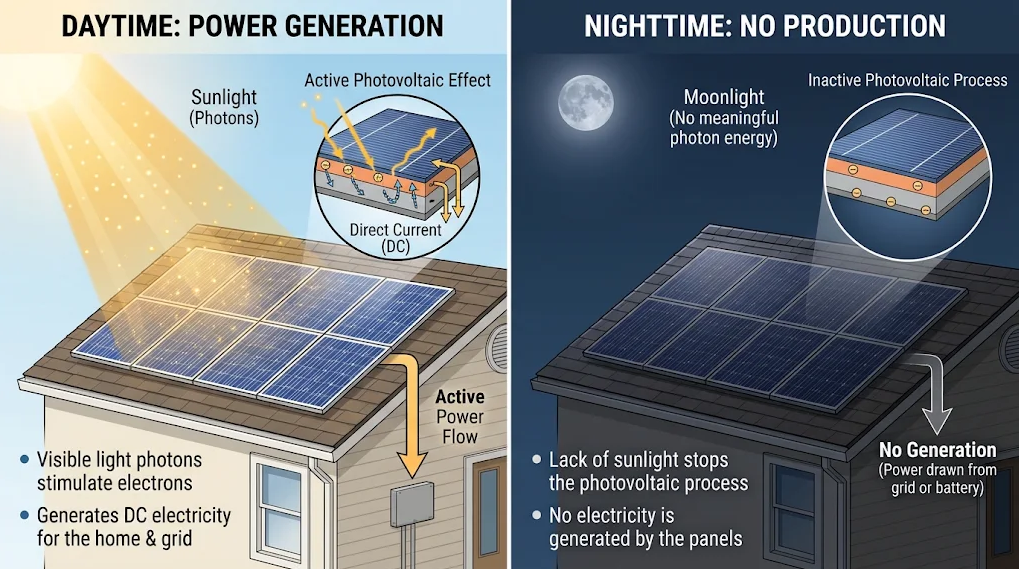
Sunlight supplies the energy that frees the electrons. Without it, nothing frees them, and the current stops. At night, the ordinary light around a home carries too little energy to produce useful household power, and no meaningful amount of daylight is arriving.
Output does not switch off in a single instant. It falls as the Sun lowers and light fades, and it is already reduced in the late afternoon because low sun angles send light through more atmosphere. Eventually the DC the panels send to the inverter drops too low for the inverter to operate usefully. Exact thresholds vary by equipment.
What Happens to Solar Power When the Sun Goes Down?
As light fades, panel output falls toward zero, the inverter has less DC to convert, and the home needs another source. Which source it uses depends on the system.
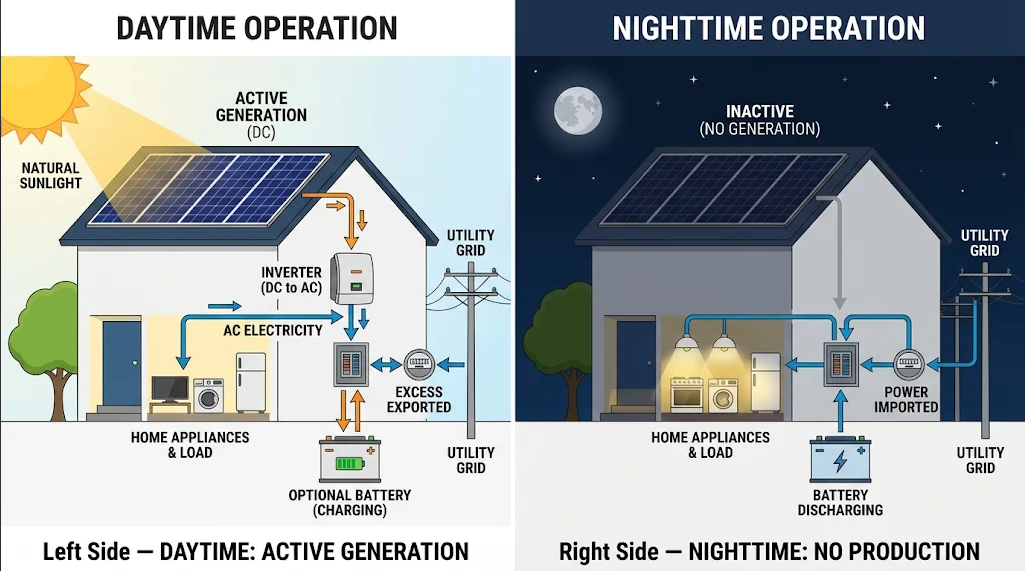
| Feature | Daytime | Night |
|---|---|---|
| Solar generation | Panels produce DC, and the inverter converts it to AC | None, or too little to be useful |
| Main electricity source | Solar first, with the grid or a battery filling gaps | Battery, grid, or both |
| Battery behavior | Charges from surplus solar, if there is a battery | Discharges to supply the home, if there is a battery |
| Grid interaction | May export surplus where allowed, or import if solar is short | Imports whatever the battery cannot supply |
In a grid connected home with no battery, the changeover is invisible: the grid simply supplies everything once solar stops. In a home with a battery, stored energy is used first, depending on the settings, and the grid fills any gap. In an off grid home, the battery alone, sometimes with a backup generator, supplies the night.
Every one of these behaviors depends on equipment configuration and on utility arrangements, so two solar homes on the same street can behave differently after sunset.
How Does Solar Power Work at Night?
Solar power works at night indirectly. The panels are idle, but the home can still use solar energy that was stored, or draw other power. There are four main routes.
Solar Battery Storage
A battery stores surplus solar energy produced during the day, then releases it after sunset. This lets a home use its own solar energy in the evening instead of exporting it and buying power back later. A battery is optional, and not every solar installation includes one.
Grid Electricity
Most solar homes are connected to the utility grid, and the grid keeps supplying electricity at night just as it would without panels. In this setup the solar panels reduce how much grid power the home buys during the day, but the nighttime supply comes from the utility.
Net Metering and Export Credits
Net metering and similar schemes are billing arrangements, not a second power supply. When a solar system exports surplus electricity during the day, the utility may credit the owner, and those credits can offset the cost of grid electricity bought at night. The home still imports real grid power after dark.
These rules are not universal. They vary by country, region and utility:
- United States: net metering depends on the state and utility. California, for example, changed its rules in 2023, according to EnergySage. Some utilities also use time of use rates, so exported daytime power can earn less than the cost of evening power, a point raised by Aurora Solar.
- United Kingdom: the Smart Export Guarantee, launched January 1, 2020 and regulated by Ofgem, requires larger suppliers to offer a tariff that pays for exported electricity. Suppliers set their own rates.
- Australia: exports are typically paid through a feed in tariff set by the electricity retailer, according to Solar Calculator Australia.
- Canada: programs are set by province and utility, so check local rules. I did not verify the details.
Battery and Grid Combination
Many modern systems use both. A battery supplies the evening, and the grid covers anything the battery cannot, such as an unusually large load or a depleted battery. How they share the work depends on settings, which an installer can configure. Some owners prioritize the battery for self use, while others hold some charge in reserve for outages.
How Solar Batteries Power Your Home After Sunset
A solar battery turns daytime surplus into evening supply. The usual path is: Sunlight → Solar panels → Inverter or charging system → Battery storage → Discharge after sunset → Home appliances.
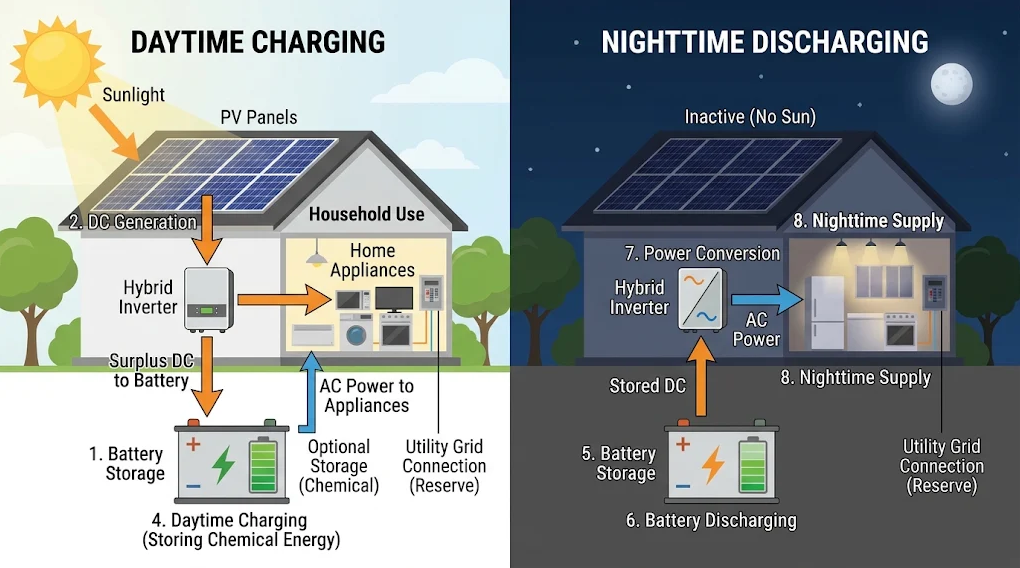
- Panels generate DC during the day. Sunlight produces direct current, as described earlier.
- The home uses what it needs first. Anything the household is consuming at that moment is supplied directly.
- Surplus goes to the battery. A hybrid inverter, charge controller or battery inverter sends the extra energy to the battery, either as DC or after conversion to AC, depending on how the system is coupled.
- The battery stores the energy chemically. The battery holds energy in chemical form, not as electricity in a tank.
- After sunset, the battery discharges. The battery releases DC, and an inverter or hybrid inverter converts it into AC for the home.
- Appliances use the power. Lights, refrigerators and other loads draw from the battery, and the grid covers any shortfall in a grid connected home.
Battery specifications use terms that are easy to confuse:
| Term | What it means | Why it matters at night |
|---|---|---|
| Kilowatt hour (kWh) | A quantity of energy, like the size of a fuel tank | Decides how long the battery can keep supplying power |
| Kilowatt (kW) | A rate of power, like how fast fuel can flow | Decides how many appliances can run at the same moment |
| Usable capacity | The part of the battery’s total kWh that the system allows you to use | The number to use when planning, not the nominal size |
| Depth of discharge | The percentage of capacity that can be drained safely | Reduces nominal capacity to usable capacity |
| Round trip efficiency | The share of stored energy that comes back out | Some energy is lost as heat in charging and discharging |
Hypothetical example. The numbers below are assumptions made for illustration, not a real product or a typical home.
- Battery: 10 kWh nominal, 9 kWh usable, power rating 5 kW.
- Round trip efficiency: 90 percent.
- On a sunny day, 10 kWh of surplus solar energy is sent to the battery.
- The household uses 12 kWh between 6 pm and 6 am, with an average load of 1 kW and a peak of 4 kW.
Because of the 90 percent efficiency, about 9 kWh can come back out, which matches the usable capacity. That covers 9 of the 12 kWh, or about three quarters of the night, and the grid would supply the remaining 3 kWh. The 4 kW peak is below the 5 kW rating, so the battery can handle it. If the household ran several large appliances at once and demanded 6 kW, the battery could not supply all of it at once, and a grid connected home would pull the difference from the grid.
The same battery would last longer or shorter depending on the load. At an average of 1.5 kW, 9 kWh would last about 6 hours. At 3 kW it would last about 3 hours. Real results depend on household demand, battery capacity, inverter limits and energy losses, so there is no universal battery runtime.
This is why battery sizing matters. A battery sized for evening use may not cover a long winter night, and a battery with a low kW rating may not run heavy appliances even if it has plenty of kWh.
What Happens at Night in Different Solar System Types?
The answer depends on the type of system. This table compares the four common setups.
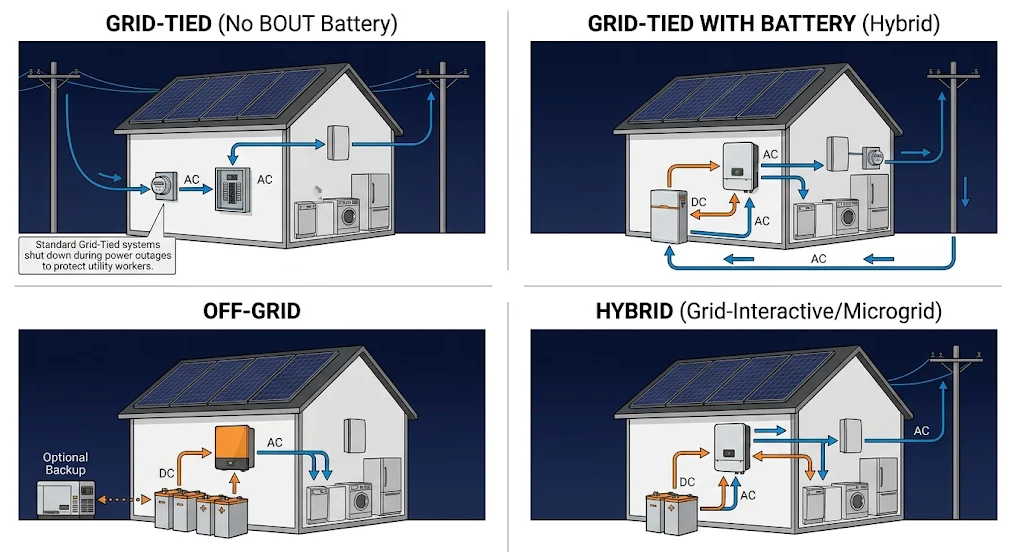
| System type | Daytime source | Nighttime source | Battery | Grid dependency | Blackout backup |
|---|---|---|---|---|---|
| Grid tied, no battery | Solar first, grid fills gaps, surplus may be exported | Grid | No | High | Typically none, because the inverter shuts down |
| Grid tied with battery | Solar, battery charging, surplus may be exported | Battery first, then grid | Yes | Moderate | Possible only if built for backup, not automatic |
| Off grid | Solar charges the battery | Battery, plus a generator if installed | Yes, essential | None | Not applicable, it runs on its own until the battery is empty |
| Hybrid | Solar, battery and grid according to settings | Battery, grid or both | Yes | Moderate, adjustable | Possible with backup capable equipment and isolation |
Three notes on the table:
- Off grid: with no utility to fall back on, the battery must be sized for the longest stretch of low sun and heavy use. If the charge runs out, the options are a backup generator, other energy sources, or reducing loads.
- Hybrid: a hybrid inverter and battery can follow rules, such as using the battery in the evening, buying grid power at cheaper times, or holding some charge back for outages. The exact behavior depends on the settings.
- Outages: the last column is the one most often misunderstood. It is covered in detail below.
Can Moonlight Generate Electricity Through Solar Panels?
In theory a tiny amount, in practice none you can use. Moonlight is reflected sunlight, so it contains photons of the same kind. But it is extremely weak. Sunlight is roughly 400,000 times brighter than the full Moon, and the Moon reflects only about 12 percent of the light that falls on it.
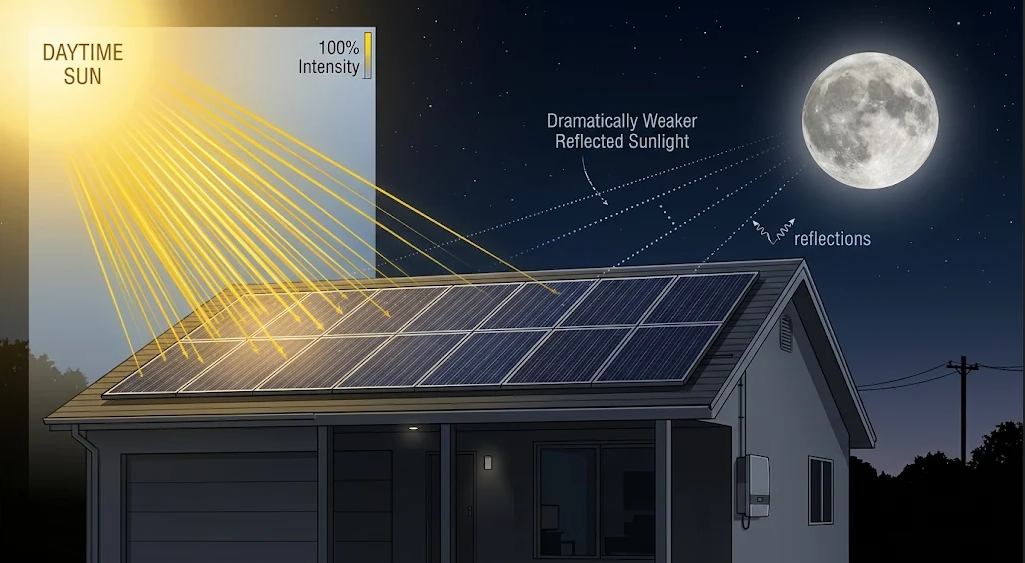
A PV cell can respond to any photon with enough energy, so a panel under a full Moon may produce a minuscule electrical signal. A crude proportional scaling would put a 400 watt panel at around one milliwatt. That is a rough illustration, not a measured result, since real cells behave differently at very low light.
The practical problem is the inverter. Inverters need a minimum amount of DC power before they start operating, and a milliwatt is far below that. So the output cannot be turned into household AC power. There is a big difference between a theoretical electrical response and practical household electricity production. Moonlight cannot meaningfully power an ordinary home.
Are There Solar Panels That Work at Night?
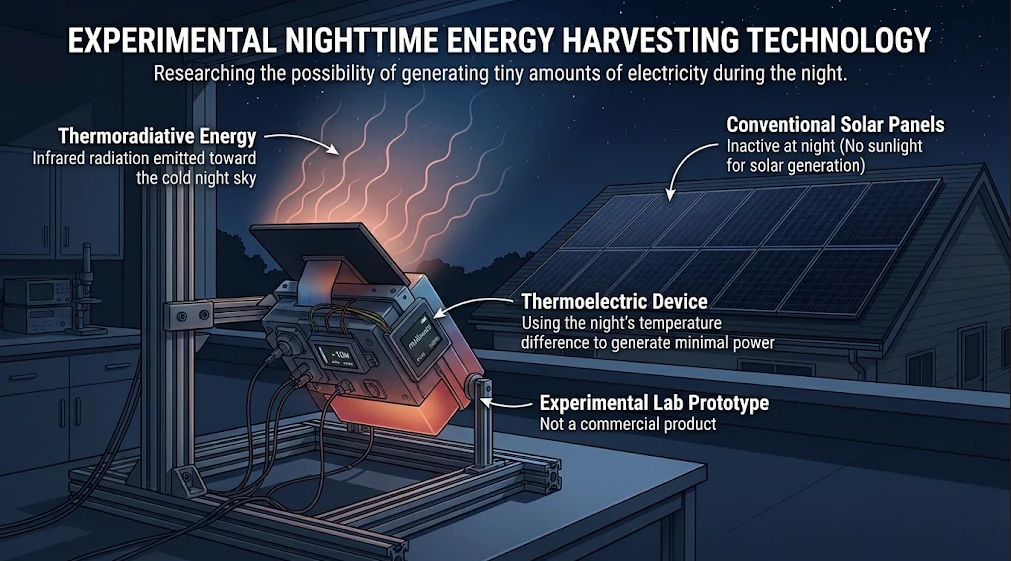
Short answer: not in any meaningful commercial form that I found. Researchers have built experimental devices that produce electricity at night, but their output is tiny compared with a rooftop panel. A homeowner cannot currently buy a conventional solar panel that generates meaningful electricity throughout the night. This reflects the sources I reviewed, which describe the technology as early stage.
How Nighttime Energy Harvesting Works
At night the Earth radiates heat into space as infrared light. Two ideas try to turn that into electricity:
- Thermoradiative devices generate power by emitting infrared light toward the cold night sky. Researchers describe them as working like a solar cell in reverse.
- PV plus thermoelectric systems use the small temperature difference that develops at night between a cooled solar cell and the surrounding air.
| Research | Approach | Reported result | Status |
|---|---|---|---|
| UNSW, ACS Photonics, 2022 | Thermoradiative diode | About 100,000 times less power than a solar panel; theory suggests up to about one tenth of a solar cell | Laboratory demonstration |
| UC Davis, concept, 2020 | Thermoradiative cell | Up to about 50 watts per square meter under ideal conditions, about a quarter of a daytime panel | Theoretical concept and early prototypes |
| Stanford, Applied Physics Letters, 2022 | PV cell with a thermoelectric generator | About 50 milliwatts per square meter on a clear night | Prototype built with off the shelf components |
Two cautions apply. First, the UC Davis figure is a theoretical ceiling, while the Stanford figure is a measurement, and the two differ by about a thousand times. Second, the Stanford team reported that powering conventional lights would still need roughly 20 square meters of panels, according to a secondary report. I did not open the original papers, so check the exact details before quoting them.
Can Solar Panels Work at Night in the Future?
Possibly, in niche uses. The UNSW team said the technology might one day power small devices or help recharge batteries, but they also called the present result very low power. These devices are not rooftop panels with a night mode. For now, the practical way to use solar at night is still storage and the grid.
Do Solar Panels Work at Night During a Power Outage?
Usually not by themselves. Panels make no power at night, and a standard grid tied system also shuts down when the grid fails. According to the U.S. Department of Energy, residential solar panels alone are not enough for resilience, because solar systems generally depend on the grid to produce power and are designed to switch off if grid power cuts out.
This is called anti islanding protection. It stops a home system from feeding power into lines that utility workers may be repairing.
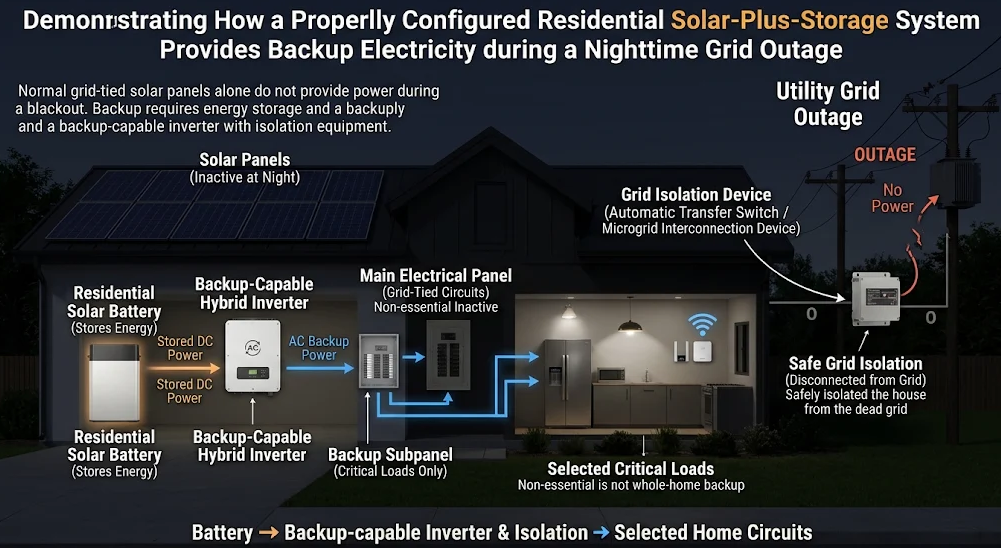
A battery alone does not automatically fix this. Backup power needs equipment designed for it: an inverter that can operate on its own, storage, and a way to isolate the home from the grid. The DOE says panels need a properly configured inverter and a storage system to produce power independently. Many installations also feed only selected circuits, often called critical loads, instead of the whole house.
When the equipment is designed for it, solar plus storage works well. The DOE describes systems that detect a loss of grid power and switch to an islanded mode within seconds, and says solar and storage can keep delivering power, even at night, in a long outage. At night the battery carries the load until it runs low, and the sun can recharge it the next day if the system is set up for that.
Never assume your system has backup. Ask your installer in writing whether it works during an outage and which circuits it covers.
How Can You Make the Most of Solar Energy After Sunset?
There is no one size fits all answer, but these steps help most homeowners:
- Know your nighttime use. Check your utility data or smart meter for the kWh you use after sunset.
- Choose storage if it fits. A battery makes sense in some situations, such as limited export credits, high evening rates or a wish for backup power. It is not necessary for everyone.
- Use efficient appliances. Lower evening loads mean a smaller battery or less grid use.
- Shift flexible use to the daytime. Running a dishwasher, laundry or EV charging while the panels are producing uses solar energy directly.
- Understand your export policy. Know how your utility credits or pays for exports, and whether rates change by time of day.
- Ask about backup operation. Confirm whether the system supports critical loads and how long they would run.
- Monitor your settings. Review battery and inverter modes from time to time, since they affect when stored energy is used.
Frequently Asked Questions
Do solar panels work at night without a battery?
The panels do not, but a grid connected home keeps receiving grid power. Export credits, where offered, may offset the cost. An off grid home with no battery has no solar power at night, apart from a generator or another source.
Can solar panels generate electricity from moonlight?
A tiny, unusable amount at most. Moonlight is about 400,000 times fainter than sunlight, which is far below what an inverter needs.
Can solar panels charge batteries during the day for nighttime use?
Yes. Surplus solar energy can be sent to a battery through a hybrid inverter, charge controller or battery inverter, and the battery supplies the home after sunset.
How long can a solar battery power a house at night?
It depends on usable kWh divided by your average load in kW. In the hypothetical example above, 9 kWh at 1.5 kW lasts about 6 hours. Heavier loads shorten it, and the battery’s kW rating limits what can run at once.
Do solar panels work during a power outage?
A standard grid tied system shuts down. A system with a battery and backup capable equipment can keep supplying selected circuits, including at night.
Does a grid tied solar system work at night?
The panels do not generate power, but the home still has electricity because the grid keeps supplying it.
Are there solar panels that generate electricity in complete darkness?
Only experimental devices that harvest infrared heat, and their output is tiny compared with a rooftop panel.
What happens to excess solar electricity during the day?
It can charge a battery, flow to the grid where permitted, or be reduced by the system’s controls. Household loads use solar power first.
Can an off grid solar system run all night?
Yes, if the battery is large enough and fully charged. If it runs low, the options are a generator, other energy sources or lower consumption.
Is a solar battery necessary for nighttime electricity?
No. Grid connected homes get nighttime power from the grid. A battery helps with outages, high evening rates, limited export credits and greater self sufficiency.