
One way to learn what is a PV system is to look at the smallest pieces and work out from there. The PV cell (also called a solar cell or photovoltaic cell) is a nonmechanical device used to convert solar power into direct current electricity. What is PV, you ask? Well, PV stands for photovoltaic, a class of materials that absorb light waves and convert them into electricity.
The photovoltaic cell is also used in answering what are photovoltaic cells and what does PV stand for. When you examine what do photovoltaic cells do, you are looking into the process of transforming light into electricity.
PV cells are made of semiconductor material. This material has unique electrical properties compared with ordinary conductors and insulators. While photons (i.e., particles of light) from the sun are the primary source of energy for PV cells, some PV cells can harness the power of man-made light sources.
what is a PV system and what does PV stand
Now that we know what is a PV system and what does PV stand for, let us examine how do PV cells work. Imagine streams of photons flowing towards a solar cell. Photons have discrete amounts of energy and different wavelengths, making up the solar spectrum. Upon hitting the solar cell, photons have three possible outcomes: photon reflection, photon transmission, or photon absorption. While reflected photons return the light to the source, and transmitted photons pass the light through the medium, only the absorbed photons will contribute to the electricity in a photovoltaic system.
How Semiconductor Materials Convert Sunlight into Electricity
When the solar cell absorbs photons, solar radiation energizes the electrons in the solar material, causing them to free themselves from their atoms. The special treatment these solar cells have received during the manufacturing process encourages the liberated electrons to flow forward through the PV cell. The uneven charge distribution at the front and back contacts creates a voltage potential, like the positive and negative ends of a battery. Conductors are attached to the PV cell to collect the electrons flowing through the PV system.
At this point, connecting the conductors to an external load with an electrical circuit will cause current to flow through the circuit, resulting in a photovoltaic current. This electricity flows from electrons in motion, creating the photovoltaic effect. This phenomenon produces electric current by converting light energy into electric energy without the moving parts needed in other energy conversions.
What is PV cells, panels, and arrays
A single solar PV cell can provide the energy for a small electrical appliance but is typically not powerful enough to contribute significantly to a PV system. A solar PV cell is a small wafer, usually 0.5 inches by 4.0 inches, and can produce 1 or 2 W of electricity. To increase the power output of a PV system, a manufacturer will often link multiple cells together into a weather-tight package called a PV panel or solar panel, also referred to as a photovoltaic module. How do you define a PV module? A solar module is a packaged product that combines more than one solar cell needed to power a solar-powered system in a portable and convenient manner.
Solar panels are further linked together to create a solar PV array, also called a photovoltaic array (define PV array). So, what is a PV array? A solar array is a configuration of two or more PV panels interconnected in series or parallel configurations. Arrays can range in size from just 2 PV panels to several hundred.
PV Cell vs. Module vs. Array vs. System
These terms describe different levels of a solar installation. The table below shows how they fit together.
| Term | What it means | What it contains | Main purpose | Simple example |
| PV cell | An individual light converting device | Semiconductor material and electrical contacts | Produces electricity from light | One silicon solar cell |
| PV module | A packaged group of connected cells | Cells, protective layers, and connections | Provides a usable panel | One rooftop solar panel |
| Solar array | A collection of PV modules | Multiple connected panels | Provides greater generating capacity | Twelve panels on a roof |
| PV system | The complete solar installation | Array, inverter, wiring, mounting, protection, and optional storage | Supplies electricity for use or export | A complete home solar installation |
The easiest way to remember the difference is that cells make up modules, modules make up arrays,
Larger arrays will create more power with the same conditions, all else being equal. The electrical energy produced by PV arrays can be direct current (DC), or photovoltaic electricity, as is typical for solar PV systems. While DC electricity can power DC electrical devices and charge batteries, most home appliances and electric power grids run on alternating current, called AC electricity. A special device known as an inverter or solar inverter is used in a PV system to complete the DC to AC conversion, providing the right type of electricity for the loads or the electrical grid.
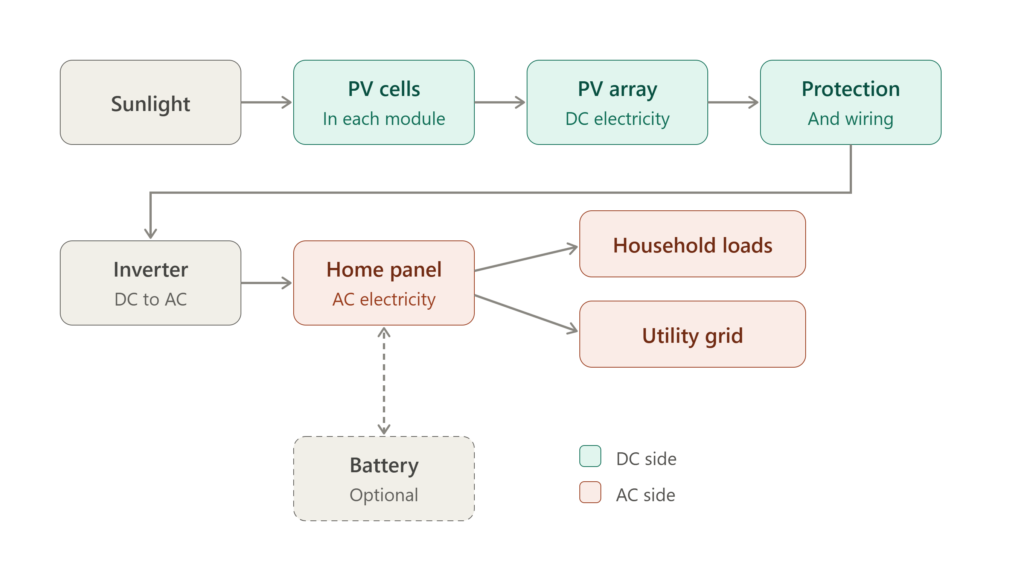
Sunlight provides abundant energy, but a PV cell or solar panel will create the most electricity when it is facing the sun optimally. A PV system utilizing a solar tracker mechanism will pursue the sun during the day to maximize the time the sun hits the PV cells. However, such trackers add to the complexity and reduce the cost-effectiveness of a solar PV system. Many PV systems use fixed tilt solar panels that remain in a single position. Solar panels in the northern hemispheres generally face south, while those in the southern hemispheres point north. The ideal angle of tilt for a PV panel depends on the PV system’s location, roof structures, solar lighting, and a balance between physical and economic performance.
PV system efficiency
Efficiency determines how well a PV system or a given component within a PV system generates electricity from available sunlight. Semiconductor material, construction type, and manufacturing process will influence photovoltaic efficiency and the overall effectiveness of a solar PV system. The efficiency of a PV panel has improved remarkably over the decades. PV panels in the 1980s only averaged less than 10% efficiency during the mid-1980s, but these numbers jumped to about 15% by 2015. Meanwhile PV modules have reached up to about 25% with new technologies.
Furthermore, some experimental PV cells targeting specific products and uses have seen close to 50% efficiency on occasion. Notwithstanding improvements in the science of photovoltaics and innovative PV cells, solar panel efficiency and PV system efficiency should be taken as an indication and considered in context with other factors. The total power generation capacity of a PV system will depend on several things: the size of the PV array or PV panel, weather conditions, shading, PV orientation, and other considerations. PV system efficiency is also affected by temperature and the general quality of the system’s installation. All of these affect the energy output of a PV system.PV system applications
A photovoltaic solar system can be as small as the electricity need for one device or as substantial as an electricity-generating system needed to power an entire utility. Photovoltaic systems can directly power a pump or motor on sunny days or even provide electricity to the home or the electric grid. With support from a battery, a PV system can create a surplus of electricity on sunny days that will be sufficient to power a home, appliance, or electronic device on cloudy days or at night. Such electricity generation from PV cells is particularly useful for individual items, home electricity, and remote locations that lack electricity access points.
Photovoltaic systems that are off-grid or utility interactive provide an independent and continuous electricity supply with no interference with the larger electricity grid. Alternatively, a photovoltaic electricity system can provide electricity in a distributed manner. The distributed electricity production from the photovoltaic arrays has the advantage of being easy to install, particularly against locations where the electricity grid is unavailable or impossible to reach.
The electricity production of such PV systems generally does not interfere much with the surrounding environment, particularly if the solar panels and arrays are mounted onto surfaces. Finally, arrays on a larger scale (1 MW and up) can potentially contribute significantly to cleaner electricity production, cleaner power generation, electricity infrastructure and the general electricity supply.
• History of photovoltaic systems
The history of photovoltaic technology reaches almost as far back as the history of the space race itself. The first working PV cell was developed by Bell Telephone researchers in 1954. Towards the end of the 1950s, the first PV cells were powering US space satellites, showing the potential application for satellite power, and other PV applications in space.
By the late 1970s, photovoltaic panels provided electricity in remote areas with no access to electricity grids. From 2004, grid-connected PV systems became a prominent feature in the American landscape and were present on residential, commercial, and utility-scale arrays exceeding 1-MW in electric generating capacity. Technology, cost per unit, financial incentives, government policies, tax credits, and net metering have all played an important part in promoting the use of photovoltaic electricity production since the 2000s.
The electric generating capacity of utility-scale PV electricity production rose from about 6,000,000 kWh (6 million kWh) of PV electricity produced in 2004 to about 292,817,000,000 kWh (292 billion kWh) of photovoltaic electricity in 2025. Meanwhile, grid-connected ‘small-scale’ PV electricity production (less than 1000 kW of generation capacity) grew from about 18,812,000 kWh (18 billion kWh) in 2016 to about 93,148,000,000 kWh (93 billion kWh) in 2025.
Some properties use one, while others combine different solar technologies.
Frequently Asked Questions
1. What does PV stand for in solar power?
PV stands for photovoltaic. It describes technology that converts light directly into electricity using suitable materials, usually semiconductors.
2. What is a PV cell?
A PV cell is a semiconductor device that converts sunlight into electrical energy through the photovoltaic effect.
3. How do PV cells work?
PV cells absorb energy from light and use their internal electrical structure to separate charges. When connected to a circuit, these charges produce direct current.
4. What is a PV module?
A PV module is a packaged assembly of interconnected solar cells. It is commonly called a solar panel.
5. What is the difference between a PV module and a solar array?
A PV module is one packaged panel. A solar array is a group of connected modules working together.
6. What is a PV system?
A PV system is the complete installation, including the modules and the equipment needed to mount, connect, protect, and use their electrical output.
7. Do photovoltaic cells produce AC or DC electricity?
PV cells produce direct current (DC). A typical household system uses an inverter to convert DC into alternating current (AC).
8. Does every PV system need a battery?
No. Grid connected systems can operate without batteries. Off grid systems commonly need storage or another source of electricity to meet demand when sunlight is unavailable.
9. Are photovoltaic cells and solar panels the same thing?
No. A solar panel generally contains many photovoltaic cells connected and packaged together. The cell is the individual electricity generating device.
10. What factors affect PV system performance?
Sunlight, shading, temperature, panel positioning, system design, electrical losses, dirt, and equipment condition can all affect output.
The Relationship Between PV Cells and Complete Solar Systems
Photovoltaic technology becomes easier to understand when you separate the parts. A cell converts light into electricity. A module packages connected cells into a panel. An array brings multiple modules together, and a complete PV system adds the electrical and mechanical equipment needed to use the power.
Once you understand these differences, solar specifications and installation quotes become easier to read, and you can make more informed decisions when comparing solar equipment.